
m6A Regulator Information
General Information of the m6A Regulator (ID: REG00021)
| Regulator Name | RNA-binding motif protein 15B (RBM15B) | ||||
|---|---|---|---|---|---|
| Synonyms |
One-twenty two protein 3; HsOTT3; HuOTT3; Putative RNA-binding protein 15B; OTT3
Click to Show/Hide
|
||||
| Gene Name | RBM15B | ||||
| Sequence |
MKRQSERDSSPSGRGSSSSAKRPREREREAEAGGRRAAHKASGGAKHPVPARARDKPRGS
GSGGGGHRDGRGTGDANHRASSGRSSGSGAGGGGRGGKASGDPGASGMSPRASPLPPPPP PPGAEPACPGSSAAAPEYKTLLISSLSPALPAEHLEDRLFHQFKRFGEISLRLSHTPELG RVAYVNFRHPQDAREARQHALARQLLLYDRPLKVEPVYLRGGGGSSRRSSSSSAAASTPP PGPPAPADPLGYLPLHGGYQYKQRSLSPVAAPPLREPRARHAAAAFALDAAAAAAVGLSR ERALDYYGLYDDRGRPYGYPAVCEEDLMPEDDQRATRNLFIGNLDHSVSEVELRRAFEKY GIIEEVVIKRPARGQGGAYAFLKFQNLDMAHRAKVAMSGRVIGRNPIKIGYGKANPTTRL WVGGLGPNTSLAALAREFDRFGSIRTIDHVKGDSFAYIQYESLDAAQAACAKMRGFPLGG PDRRLRVDFAKAEETRYPQQYQPSPLPVHYELLTDGYTRHRNLDADLVRDRTPPHLLYSD RDRTFLEGDWTSPSKSSDRRNSLEGYSRSVRSRSGERWGADGDRGLPKPWEERRKRRSLS SDRGRTTHSPYEERSRTKGSGQQSERGSDRTPERSRKENHSSEGTKESSSNSLSNSRHGA EERGHHHHHHEAADSSHGKKARDSERNHRTTEAEPKPLEEPKHETKKLKNLSEYAQTLQL GWNGLLVLKNSCFPTSMHILEGDQGVISSLLKDHTSGSKLTQLKIAQRLRLDQPKLDEVT RRIKQGSPNGYAVLLATQATPSGLGTEGMPTVEPGLQRRLLRNLVSYLKQKQAAGVISLP VGGSKGRDGTGMLYAFPPCDFSQQYLQSALRTLGKLEEEHMVIVIVRDTA Click to Show/Hide
|
||||
| Family | RRM Spen family | ||||
| Function |
RNA-binding protein that acts as a key regulator of N6-methyladenosine (m6A) methylation of RNAs, thereby regulating different processes, such as alternative splicing of mRNAs and X chromosome inactivation mediated by Xist RNA. Associated component of the WMM complex, a complex that mediates N6-methyladenosine (m6A) methylation of RNAs, a modification that plays a role in the efficiency of mRNA splicing and RNA processing. Plays a key role in m6A methylation, possibly by binding target RNAs and recruiting the WMM complex. Involved in random X inactivation mediated by Xist RNA: acts by binding Xist RNA and recruiting the WMM complex, which mediates m6A methylation, leading to target YTHDC1 reader on Xist RNA and promoting transcription repression activity of Xist. Functions in the regulation of alternative or illicit splicing, possibly by regulating m6A methylation. Inhibits pre-mRNA splicing. Also functions as a mRNA export factor by acting as a cofactor for the nuclear export receptor NXF1.
Click to Show/Hide
|
||||
| Gene ID | 29890 | ||||
| Uniprot ID | |||||
| Regulator Type | WRITER ERASER READER | ||||
| Mechanism Diagram | Click to View the Original Diagram | ||||
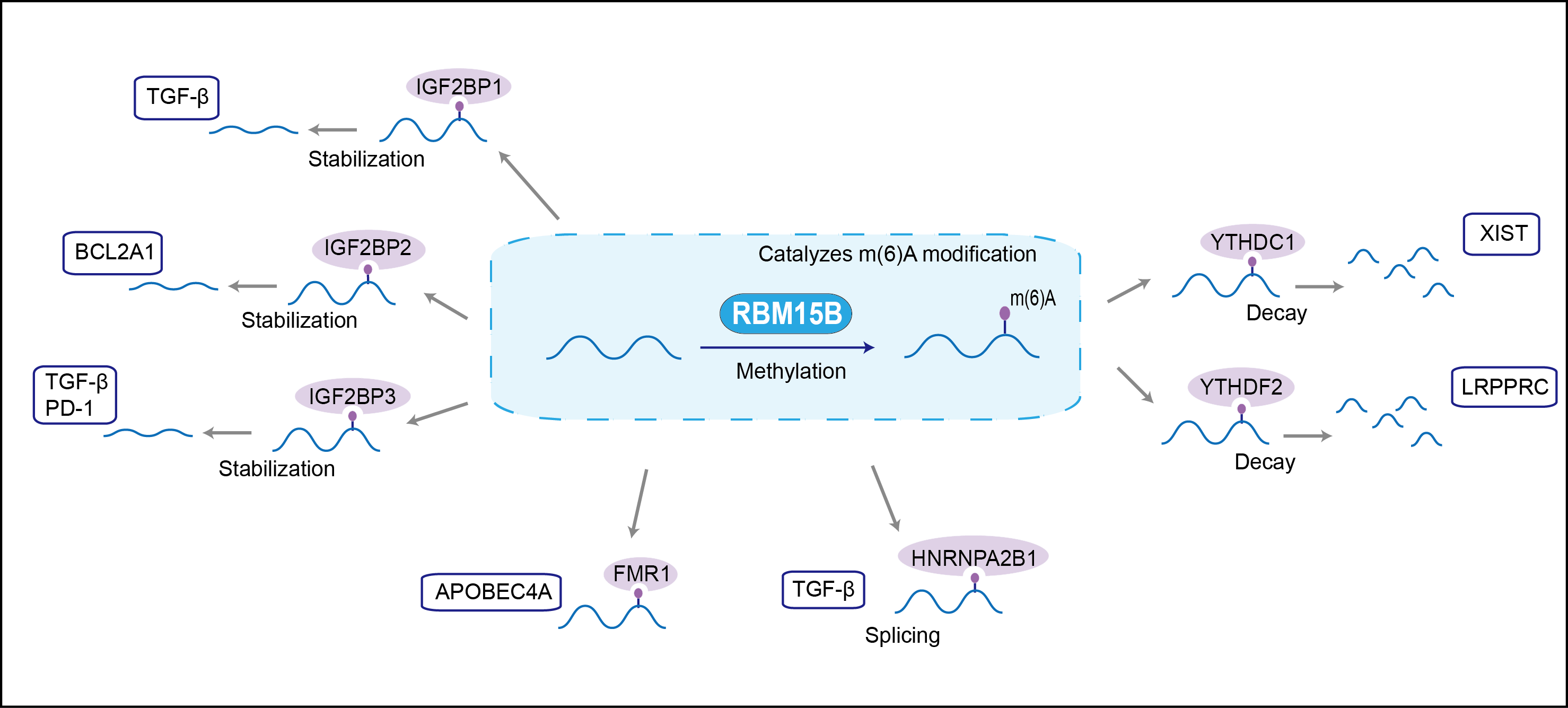
|
|||||
| Target Genes | Click to View Potential Target Genes of This Regulator | ||||
Full List of Target Gene(s) of This m6A Regulator and Corresponding Disease/Drug Response(s)
RBM15B can regulate the m6A methylation of following target genes, and result in corresponding disease/drug response(s). You can browse corresponding disease or drug response(s) resulted from the regulation of certain target gene.
Browse Target Gene related Disease
Browse Target Gene related Drug
Putative C->U-editing enzyme APOBEC-4 (APOBEC4)
Ovarian cancer [ICD-11: 2C73]
| In total 1 item(s) under this disease | ||||
| Experiment 1 Reporting the m6A-centered Disease Response of This Target Gene | [1] | |||
| Responsed Disease | Ovarian cancer [ICD-11: 2C73] | |||
In-vitro Model |
HEY | Ovarian serous adenocarcinoma | Homo sapiens | CVCL_0297 |
| THP-1 | Childhood acute monocytic leukemia | Homo sapiens | CVCL_0006 | |
| Response Summary | Putative C->U-editing enzyme APOBEC-4 (APOBEC4) was found to be significantly correlated with m6A regulators such as WTAP, METTL14, ZC3H13, RBM15B, and FMR1. APOBEC3A was identified as a protective factor from comprehensive analyses based on the immune microenvironment and genomic instability of ovarian cancer. APOBEC3A had the potential to serve as a promising prognostic biomarker for foretelling the survival and immunotherapy response of ovarian cancer patients. | |||
Translocating chain-associated membrane protein 2 (TRAM2)
Liver cancer [ICD-11: 2C12]
| In total 1 item(s) under this disease | ||||
| Experiment 1 Reporting the m6A-centered Disease Response of This Target Gene | [2] | |||
| Responsed Disease | Hepatocellular carcinoma [ICD-11: 2C12.02] | |||
| Responsed Drug | Sorafenib | Approved | ||
| Target Regulation | Up regulation | |||
In-vitro Model |
SK-HEP-1 | Liver and intrahepatic bile duct epithelial neoplasm | Homo sapiens | CVCL_0525 |
| Huh-7 | Adult hepatocellular carcinoma | Homo sapiens | CVCL_0336 | |
| L-02 | Endocervical adenocarcinoma | Homo sapiens | CVCL_6926 | |
| Hep-G2.215 (Hep-G2.215 were purchased from the Shanghai Cell Bank of the Chinese Academy of Sciences) | ||||
| Hep-G2 | Hepatoblastoma | Homo sapiens | CVCL_0027 | |
| HCCLM3 | Adult hepatocellular carcinoma | Homo sapiens | CVCL_6832 | |
| 7721 (Human hepatic malignant cell line) | ||||
| In-vivo Model | HCC-LM3 cells transfected with sh-NC and sh-RBM15B-3 were injected into the axilla or tail vein of mice. | |||
| Response Summary | Overexpression of RBM15B promotes HCC cell proliferation and invasion and induces sorafenib resistance in HCC cells. RBM15B is transcriptionally activated by YY1 and regulates the stability of Translocating chain-associated membrane protein 2 (TRAM2) mRNA in an m6A-dependent manner. | |||
Phospholipid hydroperoxide glutathione peroxidase GPX4 (GPX4)
Colon cancer [ICD-11: 2B90]
| In total 1 item(s) under this disease | ||||
| Experiment 1 Reporting the m6A-centered Disease Response of This Target Gene | [3] | |||
| Responsed Disease | Colon adenocarcinoma [ICD-11: 2B90.Y] | |||
| Target Regulation | Up regulation | |||
In-vitro Model |
SW480 | Colon adenocarcinoma | Homo sapiens | CVCL_0546 |
| HT29 | Colon cancer | Mus musculus | CVCL_A8EZ | |
| In-vivo Model | To develop the syngeneic model, 1 × 10⁶ MC38-Ctrl or MC38-Gpx4KD cells were injected subcutaneously into the right flank of C57BL/6 mice. | |||
Proliferating cell nuclear antigen (PCNA)
Prostate cancer [ICD-11: 2C82]
| In total 1 item(s) under this disease | ||||
| Experiment 1 Reporting the m6A-centered Disease Response of This Target Gene | [4] | |||
| Responsed Disease | Prostate cancer [ICD-11: 2C82] | |||
| Target Regulation | Down regulation | |||
In-vitro Model |
PC-3 | Prostate carcinoma | Homo sapiens | CVCL_0035 |
| DU145 | Prostate carcinoma | Homo sapiens | CVCL_0105 | |
| 22Rv1 | Prostate carcinoma | Homo sapiens | CVCL_1045 | |
| RWPE-1 | Normal | Homo sapiens | CVCL_3791 | |
| In-vivo Model | The mice were kept under standard conditions and provided with care in accordance with established protocols. For the experiment, 1 × 10⁶ DU145 cells with reduced RBM15B expression and corresponding control cells were injected subcutaneously into the right flank of each nude mouse. Tumor length (L) and width (W) were measured weekly, and tumor volume was calculated using the formula: Volume = (W2 × L) / 2. Four weeks following the injections, mice were euthanized by intraperitoneal administration of sodium pentobarbital at a dose of 150 mg/kg. Tumors were then surgically removed and weighed. | |||
Unspecific Target Gene
Liver cancer [ICD-11: 2C12]
| In total 1 item(s) under this disease | ||||
| Experiment 1 Reporting the m6A-centered Disease Response of This Target Gene | [5] | |||
| Responsed Disease | Hepatocellular carcinoma [ICD-11: 2C12.02] | |||
| Responsed Drug | Teniposide | Approved | ||
| Target Regulation | Up regulation | |||
| Pathway Response | Nucleotide excision repair | hsa03420 | ||
| mTOR signaling pathway | hsa04150 | |||
| Cell Process | DNA repair | |||
In-vitro Model |
Hep-G2 | Hepatoblastoma | Homo sapiens | CVCL_0027 |
| Huh-7 | Adult hepatocellular carcinoma | Homo sapiens | CVCL_0336 | |
| In-vivo Model | To establish a tumour model, C57BL/6 mice were intraperitoneal injected with 25 mg/kg diethylnitrosamine at 2 weeks of age. | |||
| Response Summary | The m6A model includes LRPPRC, YTHDF2, KIAA14219, and RBM15B, classified A-hepatocellular carcinoma patients into high/low-risk subtypes. The expression of Immunosuppressive cytokines DNMT1/EZH2 was up-regulated in A-hepatocellular carcinoma patients, and teniposide can be a potential therapeutic drug for A-hepatocellular carcinoma. | |||
Coronary artery disease [ICD-11: BA8Z]
| In total 1 item(s) under this disease | ||||
| Experiment 1 Reporting the m6A-centered Disease Response of This Target Gene | [6] | |||
| Responsed Disease | Coronary artery disease [ICD-11: BA8Z] | |||
In-vitro Model |
HUVEC-CS
|
N.A. | Homo sapiens | CVCL_0F27 |
Translocating chain-associated membrane protein 2 (TRAM2)
Sorafenib
[Approved]
| In total 1 item(s) under this drug | ||||
| Experiment 1 Reporting the m6A-centered Drug Response of This Target Gene | [2] | |||
| Responsed Disease | Hepatocellular carcinoma | ICD-11: 2C12.02 | ||
| Target Regulation | Up regulation | |||
| In-vitro Model | SK-HEP-1 | Liver and intrahepatic bile duct epithelial neoplasm | Homo sapiens | CVCL_0525 |
| Huh-7 | Adult hepatocellular carcinoma | Homo sapiens | CVCL_0336 | |
| L-02 | Endocervical adenocarcinoma | Homo sapiens | CVCL_6926 | |
| Hep-G2.215 (Hep-G2.215 were purchased from the Shanghai Cell Bank of the Chinese Academy of Sciences) | ||||
| Hep-G2 | Hepatoblastoma | Homo sapiens | CVCL_0027 | |
| HCCLM3 | Adult hepatocellular carcinoma | Homo sapiens | CVCL_6832 | |
| 7721 (Human hepatic malignant cell line) | ||||
| In-vivo Model | HCC-LM3 cells transfected with sh-NC and sh-RBM15B-3 were injected into the axilla or tail vein of mice. | |||
| Response Summary | Overexpression of RBM15B promotes HCC cell proliferation and invasion and induces sorafenib resistance in HCC cells. RBM15B is transcriptionally activated by YY1 and regulates the stability of Translocating chain-associated membrane protein 2 (TRAM2) mRNA in an m6A-dependent manner. | |||
Unspecific Target Gene
Teniposide
[Approved]
| In total 1 item(s) under this drug | ||||
| Experiment 1 Reporting the m6A-centered Drug Response of This Target Gene | [5] | |||
| Responsed Disease | Hepatocellular carcinoma | ICD-11: 2C12.02 | ||
| Target Regulation | Up regulation | |||
| Pathway Response | Nucleotide excision repair | hsa03420 | ||
| mTOR signaling pathway | hsa04150 | |||
| Cell Process | DNA repair | |||
| In-vitro Model | Hep-G2 | Hepatoblastoma | Homo sapiens | CVCL_0027 |
| Huh-7 | Adult hepatocellular carcinoma | Homo sapiens | CVCL_0336 | |
| In-vivo Model | To establish a tumour model, C57BL/6 mice were intraperitoneal injected with 25 mg/kg diethylnitrosamine at 2 weeks of age. | |||
| Response Summary | The m6A model includes LRPPRC, YTHDF2, KIAA14219, and RBM15B, classified A-hepatocellular carcinoma patients into high/low-risk subtypes. The expression of Immunosuppressive cytokines DNMT1/EZH2 was up-regulated in A-hepatocellular carcinoma patients, and teniposide can be a potential therapeutic drug for A-hepatocellular carcinoma. | |||
Full List of Crosstalk(s) between m6A Modification and Epigenetic Regulation Related to This Regulator
RNA modification
m6A Target: Phospholipid hydroperoxide glutathione peroxidase GPX4 (GPX4)
| In total 1 item(s) under this m6A target | ||
| Crosstalk ID: M6ACROT00014 | ||
| Epigenetic Regulator | 28S rRNA (cytosine-C(5))-methyltransferase (NSUN5) | |
| Regulated Target | Phospholipid hydroperoxide glutathione peroxidase GPX4 (GPX4) | |
| Crosstalk relationship | m5C → m6A | |
| Disease | Colon cancer | |
References