
m6A-centered Drug Response Information
General Information of the Drug (ID: M6ADRUG0073)
| Name |
CB-839
|
||||
|---|---|---|---|---|---|
| Synonyms |
CB-839; 1439399-58-2; 2-(pyridin-2-yl)-N-(5-(4-(6-(2-(3-(trifluoromethoxy)phenyl)acetamido)pyridazin-3-yl)butyl)-1,3,4-thiadiazol-2-yl)acetamide; CB839; CB 839; UNII-U6CL98GLP4; U6CL98GLP4; N-[6-[4-[5-[(2-pyridin-2-ylacetyl)amino]-1,3,4-thiadiazol-2-yl]butyl]pyridazin-3-yl]-2-[3-(trifluoromethoxy)phenyl]acetamide; 2-(Pyridin-2-Yl)-N-(5-{4-[6-({[3-(Trifluoromethoxy)phenyl]acetyl}amino)pyridazin-3-Yl]butyl}-1,3,4-Thiadiazol-2-Yl)acetamide; 2-(PYRIDIN-2-YL)-N-{5-[4-(6-{2-[3-(TRIFLUOROMETHOXY)PHENYL]ACETAMIDO}PYRIDAZIN-3-YL)BUTYL]-1,3,4-THIADIAZOL-2-YL}ACETAMIDE; 2-Pyridineacetamide, N-(5-(4-(6-((2-(3-(trifluoromethoxy)phenyl)acetyl)amino)-3-pyridazinyl)butyl)-1,3,4-thiadiazol-2-yl)-; 2-Pyridineacetamide, N-[5-[4-[6-[[2-[3-(trifluoromethoxy)phenyl]acetyl]amino]-3-pyridazinyl]butyl]-1,3,4-thiadiazol-2-yl]-; 63J; Telaglenastat [USAN]; CB-839(Telaglenastat); Telaglenastat (USAN/INN); GTPL9053; CB-839 [WHO-DD]; CHEMBL3639788; SCHEMBL14987180; BDBM109086; HMS3741E19; HMS3873G13; AMY16835; BCP28287; EX-A1310; MFCD28167826; NSC783415; NSC795998; NSC798057; s7655; WHO 10815; AKOS025396175; ZINC169698697; CCG-270102; CS-3393; DB15232; NSC-783415; NSC-795998; NSC-798057; SB17221; NCGC00356145-11; 2-Pyridineacetamide, N-[5-[4-[6-[[2-[3-(trifluoromethoxy)phenyl]acetyl]amino]-3-pyridaz; AC-31603; AS-75090; CB839; CB 839 pound>>Telaglenastat,; DA-34988; HY-12248; FT-0767818; A14396; D11738; A857288; US8604016, 670; Q27075751; 2-Pyridineacetamide, N-[5-[4-[6-[[2-[3-(trifluoromethoxy)phenyl]acetyl]amino]-3-pyridazinyl]butyl]-1,3,4-thiadiazol-2-yl]-; N-[5-[4-[6-[[2-[3-(trifluoromethoxy)phenyl]acetyl]amino]-3-pyridazinyl]butyl]-1,3,4-thiadiazol-2-yl]-2-pyridineacetamide; N-[5-[4-[6-[[2-[3-(trifluoromethoxy)phenyl]acetyl]amino]-3-pyridazinyl]butyl]-1,3,4-thiadiazol-2-yl]-2-pyridineacetamide;CB-839; N-[6-(4-{5-[2-(pyridin-2-yl)acetamido]-1,3,4-thiadiazol-2-yl}butyl)pyridazin-3-yl]-2-[3-(trifluoromethoxy)phenyl]acetamide
Click to Show/Hide
|
||||
| Status | Phase 2 | [1] | |||
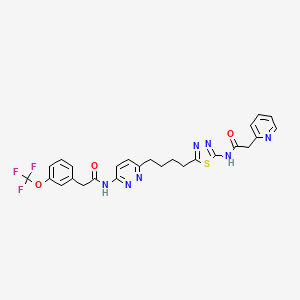
| Structure |
 |
||||
| Formula |
C26H24F3N7O3S
|
||||
| InChI |
InChI=1S/C26H24F3N7O3S/c27-26(28,29)39-20-9-5-6-17(14-20)15-22(37)31-21-12-11-18(33-34-21)7-1-2-10-24-35-36-25(40-24)32-23(38)16-19-8-3-4-13-30-19/h3-6,8-9,11-14H,1-2,7,10,15-16H2,(H,31,34,37)(H,32,36,38)
|
||||
| InChIKey |
PRAAPINBUWJLGA-UHFFFAOYSA-N
|
||||
| PubChem CID | |||||
| DrugBank ID | |||||
Full List of m6A Targets Related to This Drug
Cyclic AMP-dependent transcription factor ATF-4 (ATF4)
| In total 2 item(s) under this target gene | ||||
| Experiment 1 Reporting the m6A-centered Drug Response by This Target Gene | [2] | |||
| Response Summary | In colorectal cancer, Glutaminolysis inhibition upregulated ATF4 expression in an m6A-dependent manner to activate pro-survival autophagy through transcriptional activation of the mTOR inhibitor DDIT4. Determined the relationship between FTO alpha-ketoglutarate dependent dioxygenase (FTO), YTH N6-methyladenosine RNA binding protein 2 (YTHDF2), and ATF4. ATF4 transcriptionally upregulated DDIT4 to suppress Cyclic AMP-dependent transcription factor ATF-4 (ATF4), which induced pro-survival autophagy during glutaminolysis inhibition. | |||
| Responsed Disease | Colorectal cancer | ICD-11: 2B91 | ||
| Target Regulator | YTH domain-containing family protein 2 (YTHDF2) | READER | ||
| Target Regulation | Down regulation | |||
| Pathway Response | mTOR signaling pathway | hsa04150 | ||
| Cell Process | RNA decay | |||
| Cell growth and death | ||||
| Cell autophagy | ||||
| In-vitro Model | HCT 116 | Colon carcinoma | Homo sapiens | CVCL_0291 |
| SW480 | Colon adenocarcinoma | Homo sapiens | CVCL_0546 | |
| Experiment 2 Reporting the m6A-centered Drug Response by This Target Gene | [2] | |||
| Response Summary | In colorectal cancer, Glutaminolysis inhibition upregulated ATF4 expression in an m6A-dependent manner to activate pro-survival autophagy through transcriptional activation of the mTOR inhibitor DDIT4. Determined the relationship between FTO alpha-ketoglutarate dependent dioxygenase (FTO), YTH N6-methyladenosine RNA binding protein 2 (YTHDF2), and ATF4. Cyclic AMP-dependent transcription factor ATF-4 (ATF4) transcriptionally upregulated DDIT4 to suppress mTOR, which induced pro-survival autophagy during glutaminolysis inhibition. | |||
| Responsed Disease | Colorectal cancer | ICD-11: 2B91 | ||
| Target Regulator | Fat mass and obesity-associated protein (FTO) | ERASER | ||
| Pathway Response | mTOR signaling pathway | hsa04150 | ||
| Cell Process | RNA decay | |||
| Cell growth and death | ||||
| Cell autophagy | ||||
| In-vitro Model | HCT 116 | Colon carcinoma | Homo sapiens | CVCL_0291 |
| SW480 | Colon adenocarcinoma | Homo sapiens | CVCL_0546 | |
Serine/threonine-protein kinase mTOR (MTOR)
| In total 2 item(s) under this target gene | ||||
| Experiment 1 Reporting the m6A-centered Drug Response by This Target Gene | [2] | |||
| Response Summary | In colorectal cancer, Glutaminolysis inhibition upregulated ATF4 expression in an m6A-dependent manner to activate pro-survival autophagy through transcriptional activation of the mTOR inhibitor DDIT4. Determined the relationship between FTO alpha-ketoglutarate dependent dioxygenase (FTO), YTH N6-methyladenosine RNA binding protein 2 (YTHDF2), and ATF4. ATF4 transcriptionally upregulated DDIT4 to suppress Serine/threonine-protein kinase mTOR (MTOR), which induced pro-survival autophagy during glutaminolysis inhibition. | |||
| Responsed Disease | Colorectal cancer | ICD-11: 2B91 | ||
| Target Regulator | YTH domain-containing family protein 2 (YTHDF2) | READER | ||
| Target Regulation | Up regulation | |||
| Pathway Response | mTOR signaling pathway | hsa04150 | ||
| Autophagy | hsa04140 | |||
| Cell Process | RNA decay | |||
| Cell growth and death | ||||
| Cell autophagy | ||||
| In-vitro Model | HCT 116 | Colon carcinoma | Homo sapiens | CVCL_0291 |
| SW480 | Colon adenocarcinoma | Homo sapiens | CVCL_0546 | |
| Experiment 2 Reporting the m6A-centered Drug Response by This Target Gene | [2] | |||
| Response Summary | In colorectal cancer, Glutaminolysis inhibition upregulated ATF4 expression in an m6A-dependent manner to activate pro-survival autophagy through transcriptional activation of the mTOR inhibitor DDIT4. Determined the relationship between FTO alpha-ketoglutarate dependent dioxygenase (FTO), YTH N6-methyladenosine RNA binding protein 2 (YTHDF2), and ATF4. Serine/threonine-protein kinase mTOR (MTOR) transcriptionally upregulated DDIT4 to suppress mTOR, which induced pro-survival autophagy during glutaminolysis inhibition. | |||
| Responsed Disease | Colorectal cancer | ICD-11: 2B91 | ||
| Target Regulator | Fat mass and obesity-associated protein (FTO) | ERASER | ||
| Pathway Response | mTOR signaling pathway | hsa04150 | ||
| Autophagy | hsa04140 | |||
| Cell Process | RNA decay | |||
| Cell growth and death | ||||
| Cell autophagy | ||||
| In-vitro Model | HCT 116 | Colon carcinoma | Homo sapiens | CVCL_0291 |
| SW480 | Colon adenocarcinoma | Homo sapiens | CVCL_0546 | |
Full List of Crosstalk(s) between m6A Modification and Epigenetic Regulation Related to This Drug
| In total 4 item(s) under this drug | ||
| Crosstalk ID: M6ACROT03336 | ||
| m6A Regulator | YTH domain-containing family protein 2 (YTHDF2) | |
| m6A Target | Cyclic AMP-dependent transcription factor ATF-4 (ATF4) | |
| Epigenetic Regulator | Histone acetyltransferase p300 (P300) | |
| Regulated Target | Histone H3 lysine 18 lactylation (H3K18la) | |
| Crosstalk relationship | Histone modification → m6A | |
| Disease | Colorectal cancer | |
| Crosstalk ID: M6ACROT03342 | ||
| m6A Regulator | YTH domain-containing family protein 2 (YTHDF2) | |
| m6A Target | Serine/threonine-protein kinase mTOR (MTOR) | |
| Epigenetic Regulator | Histone acetyltransferase p300 (P300) | |
| Regulated Target | Histone H3 lysine 18 lactylation (H3K18la) | |
| Crosstalk relationship | Histone modification → m6A | |
| Disease | Colorectal cancer | |
| Crosstalk ID: M6ACROT03434 | ||
| m6A Regulator | Fat mass and obesity-associated protein (FTO) | |
| m6A Target | Cyclic AMP-dependent transcription factor ATF-4 (ATF4) | |
| Epigenetic Regulator | Histone deacetylase 1 (HDAC1) | |
| Regulated Target | Histone H3 lysine 27 acetylation (H3K27ac) | |
| Crosstalk relationship | Histone modification → m6A | |
| Disease | Colorectal cancer | |
| Crosstalk ID: M6ACROT03440 | ||
| m6A Regulator | Fat mass and obesity-associated protein (FTO) | |
| m6A Target | Serine/threonine-protein kinase mTOR (MTOR) | |
| Epigenetic Regulator | Histone deacetylase 1 (HDAC1) | |
| Regulated Target | Histone H3 lysine 27 acetylation (H3K27ac) | |
| Crosstalk relationship | Histone modification → m6A | |
| Disease | Colorectal cancer | |
References