
m6A-centered Crosstalk Information
Mechanism of Crosstalk between m6A Modification and Epigenetic Regulation
| Crosstalk ID |
M6ACROT06040
|
[1] | |||
 m6A modification
RN7SK
RN7SK
YTHDC2
m6A modification
RN7SK
RN7SK
YTHDC2
 : m6A sites
Direct
Enhancement
Non-coding RNA
RN7SK
CUL1
lncRNA miRNA circRNA : m6A sites
Direct
Enhancement
Non-coding RNA
RN7SK
CUL1
lncRNA miRNA circRNA
|
|||||
| m6A Modification: | |||||
|---|---|---|---|---|---|
| m6A Regulator | YTH domain-containing protein 2 (YTHDC2) | READER | |||
| m6A Target | RNA component of 7SK nuclear ribonucleoprotein (RN7SK) | ||||
| Epigenetic Regulation that have Cross-talk with This m6A Modification: | |||||
| Epigenetic Regulation Type | Non-coding RNA (ncRNA) | ||||
| Epigenetic Regulator | RNA component of 7SK nuclear ribonucleoprotein (RN7SK) | snRNA | View Details | ||
| Regulated Target | Cullin 1 (CUL1) | View Details | |||
| Crosstalk Relationship | m6A → ncRNA | Enhancement | |||
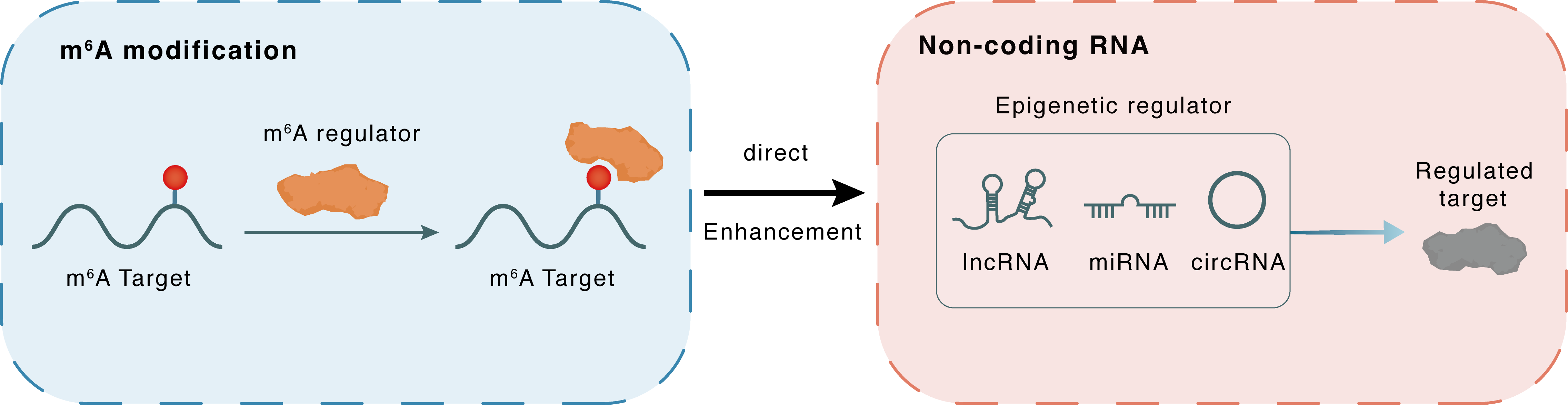
| Crosstalk Mechanism | m6A regulators directly modulate the functionality of ncRNAs through specific targeting ncRNA | ||||
| Crosstalk Summary | RNA component of 7SK nuclear ribonucleoprotein (RN7SK) was identified as a small nuclear RNA that interacts with m6A readers. m6A readers recognized and facilitated secondary structure formation of m6A-modified RN7SK, which in turn prevented m6A reader mRNA degradation from exonucleases. Thus, a positive feedback circuit between RN7SK and m6A readers is established in tumor cells. From findings on the interaction with RN7SK, m6A readers, such as EWS RNA binding protein 1 (EWSR1), KH RNA binding domain containing, signal transduction-associated 1 (KHDRBS1) and IGF2BP3, were identified and shown to boost Wnt/beta-catenin signaling and tumorigenesis by suppressing translation of Cullin 1 (CUL1) which is regulated by METTL3 and YTHDC2. | ||||
| Responsed Drug | etoposide (ETO) | ||||
| Pathway Response | Wnt signaling pathway | hsa04310 | |||
| Cell Process | mRNA decay | ||||
In-vitro Model |
BEAS-2B | Normal | Homo sapiens | CVCL_0168 | |
| NCI-H1299 | Lung large cell carcinoma | Homo sapiens | CVCL_0060 | ||
| NCI-H1975 | Lung adenocarcinoma | Homo sapiens | CVCL_1511 | ||
| A-549 | Lung adenocarcinoma | Homo sapiens | CVCL_0023 | ||
| PC-9 | Lung adenocarcinoma | Homo sapiens | CVCL_B260 | ||
| BEL-7404 | Endocervical adenocarcinoma | Homo sapiens | CVCL_6568 | ||
| BEL-7402 | Endocervical adenocarcinoma | Homo sapiens | CVCL_5492 | ||
| Hep-G2 | Hepatoblastoma | Homo sapiens | CVCL_0027 | ||
| SW1990 | Pancreatic adenocarcinoma | Homo sapiens | CVCL_1723 | ||
| PANC-1 | Pancreatic ductal adenocarcinoma | Homo sapiens | CVCL_0480 | ||
| MKN45 | Gastric adenocarcinoma | Homo sapiens | CVCL_0434 | ||
| MGC-803 | Gastric mucinous adenocarcinoma | Homo sapiens | CVCL_5334 | ||
| HCT 116 | Colon carcinoma | Homo sapiens | CVCL_0291 | ||
| HT29 | Colon cancer | Mus musculus | CVCL_A8EZ | ||
| In-vivo Model | For the generation of PDX mouse models, fresh LUSC specimens (2-3 mm3), which were from Shanghai Chest Hospital, were implanted into 4- to 6-week-old athymic nude mice (Jiesijie, Shanghai, China). After successful tumor growth was confirmed, the tumor tissues were passaged and implanted into the next generation of mice. The third to fifth generations of PDX-bearing mice were used for drug administration. When tumors reached approximately 200 mm3, mice were injected daily with DMSO (no. ST038, Beyotime Biotechnology, Shanghai, China) with or without MIT (no. S2485, 5 mg/kg, Selleck, Houston, TX) or HYD (no. S1896, 20 mg/kg, Selleck) (n = 5 mice/group). Tumor growth was monitored, and sizes were calculated by 0.5 × L × W2 (L indicating length and W indicating width). The mice were euthanized at day 28 after implantation. All animal experiments were approved by the institutional ethics committee of Shanghai Chest Hospital (approval number KS(Y)21382). | ||||