
m6A-centered Crosstalk Information
Mechanism of Crosstalk between m6A Modification and Epigenetic Regulation
| Crosstalk ID |
M6ACROT05971
|
[1] | |||
 m6A modification
LncRNA NORAD
LncRNA NORAD
WTAP
Methylation
m6A modification
LncRNA NORAD
LncRNA NORAD
WTAP
Methylation
 : m6A sites
Direct
Inhibition
Non-coding RNA
lncRNA NORAD
PUM2
lncRNA miRNA circRNA : m6A sites
Direct
Inhibition
Non-coding RNA
lncRNA NORAD
PUM2
lncRNA miRNA circRNA
|
|||||
| m6A Modification: | |||||
|---|---|---|---|---|---|
| m6A Regulator | Wilms tumor 1-associating protein (WTAP) | WRITER | |||
| m6A Target | Long intergenic non-protein coding RNA 657 (NORAD) | ||||
| Epigenetic Regulation that have Cross-talk with This m6A Modification: | |||||
| Epigenetic Regulation Type | Non-coding RNA (ncRNA) | ||||
| Epigenetic Regulator | Long intergenic non-protein coding RNA 657 (NORAD) | LncRNA | View Details | ||
| Regulated Target | Pumilio homolog 2 (PUM2) | View Details | |||
| Crosstalk Relationship | m6A → ncRNA | Inhibition | |||
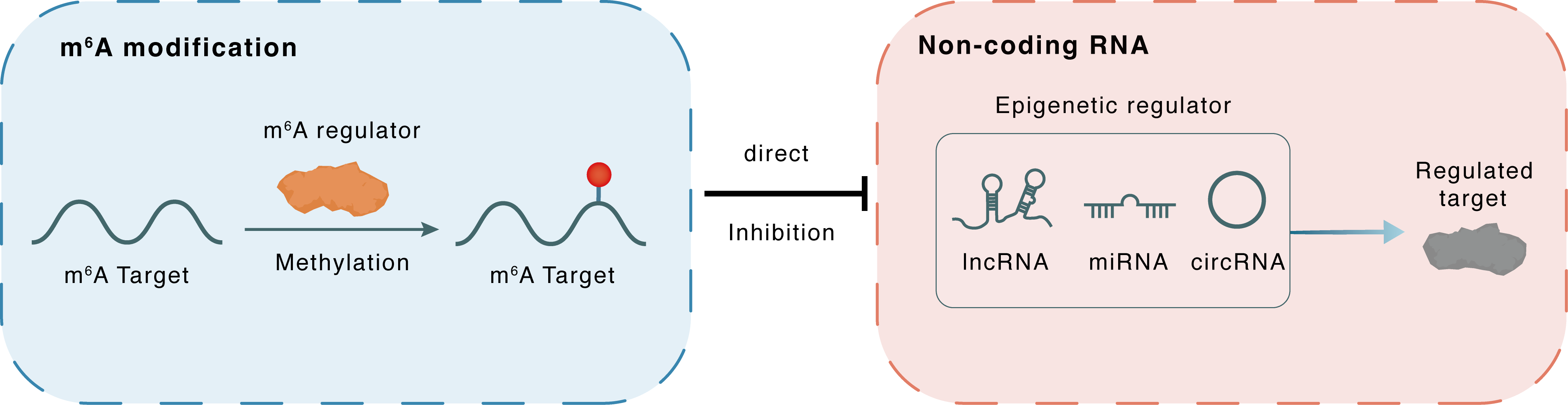
| Crosstalk Mechanism | m6A regulators directly modulate the functionality of ncRNAs through specific targeting ncRNA | ||||
| Crosstalk Summary | Subsequent loss- and gain-of-function experiments reveal WTAP is increased in senescent nucleus pulposus cells, and significantly promotes Long intergenic non-protein coding RNA 657 (NORAD) m6A modification. YTHDF2-mediated decay of NORAD is enhanced in senescent NPCs, and then deficiency of NORAD results in less sequestraion of PUMILIO proteins, contributing to the augmented activity of PUM1 and Pumilio homolog 2 (PUM2), thus repressing the expression of target E2F3 mRNAs and promoting the cellular senescence. This study shows interruption of NORAD m6A modification or the NORAD/PUMILIO/E2F3 axis could serve as a potential therapeutic target to inhibit the senescence of NPCs and development of intervertebral disc degeneration(IVDD). | ||||
| Responsed Disease | Intervertebral disc degeneration | ICD-11: FA80 | |||
In-vitro Model |
Nucleus pulposus cells (NPCs) (Nucleus pulposus cells) | ||||
| In-vivo Model | After 50g male NORAD-KO or C57 mice at age of 8 weeks were anesthetized with 3% (w/v) pentobarbital (2 ml/kg) and grouped randomly, investigators blinded to the group allocation performed the experiment. The disc levels in rat tail (Co6/7, 7/8, and 8/9) were located by palpation on the coccygeal vertebrae and confirmed by trial radiography. Needles (33-G) were used to puncture the annulus fibrosus layer though the tail skin, in parallel to the end plates. To ensure that the needle did not penetrate too deeply , the length of the needle was pre-determined according to the dimensions of annulus fibrosus and the NP , which were measured in a preliminary experiment and found to be approximately 4 mm. Five kinds of solution were prepared for intradisc injection, including AA V vector, AAV containing shPUM1, AAV containing shPUM2 for Norad KO mice, AAV vector, AAV containing shE2F3, AAVcontaining OE-E2F3 for WT mice. | ||||
Full List of Potential Compound(s) Related to This m6A-centered Crosstalk
| FA80: Intervertebral disc degeneration | 3 Compound(s) Regulating the Disease | Click to Show/Hide the Full List | ||
 Compound Name Compound Name |
Rexlemestrocel-L | Phase 3 | [2] | |
|---|---|---|---|---|
| Synonyms |
MPC-150-M
Click to Show/Hide
|
|||
| External Link | ||||
| Compound Name |
CybroCell | Phase 1/2 | [3] | |
| External Link | ||||
| Compound Name |
IDCT | Phase 1/2 | [4] | |
| Synonyms |
rebonuputemcel
Click to Show/Hide
|
|||
| External Link | ||||
References