
m6A-centered Crosstalk Information
Mechanism of Crosstalk between m6A Modification and Epigenetic Regulation
| Crosstalk ID |
M6ACROT05429
|
[1] | |||
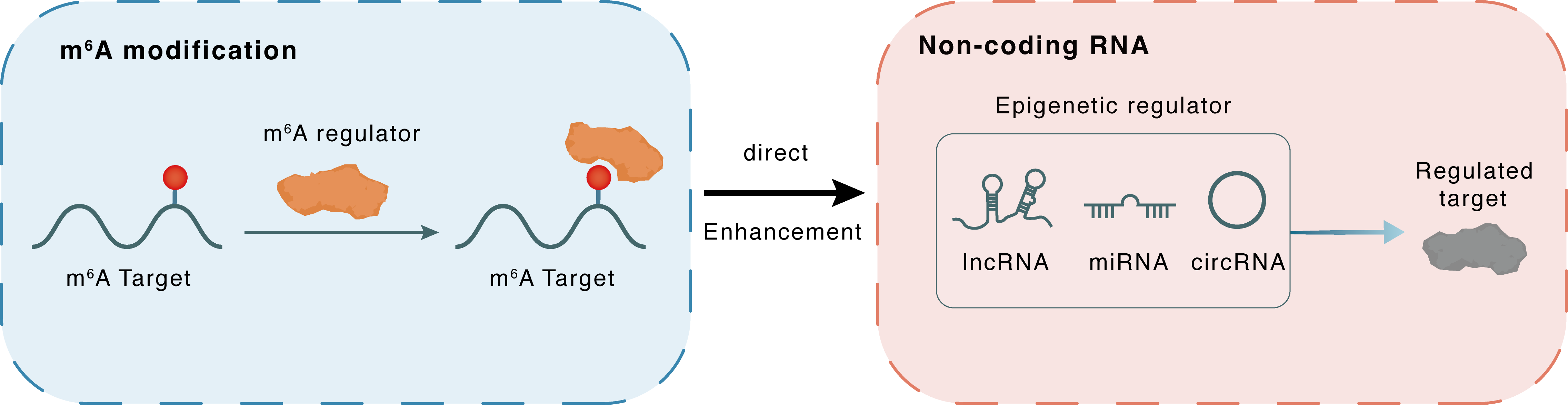 m6A modification
SEPTIN14P20
SEPTIN14P20
IGF2BP1
m6A modification
SEPTIN14P20
SEPTIN14P20
IGF2BP1
 : m6A sites
Direct
Enhancement
Non-coding RNA
LINC00266-1
SEPTIN14P20
lncRNA miRNA circRNA : m6A sites
Direct
Enhancement
Non-coding RNA
LINC00266-1
SEPTIN14P20
lncRNA miRNA circRNA
|
|||||
| m6A Modification: | |||||
|---|---|---|---|---|---|
| m6A Regulator | Insulin-like growth factor 2 mRNA-binding protein 1 (IGF2BP1) | READER | |||
| m6A Target | Septin 14 pseudogene 20 (SEPTIN14P20/LINC00266-1) | ||||
| Epigenetic Regulation that have Cross-talk with This m6A Modification: | |||||
| Epigenetic Regulation Type | Non-coding RNA (ncRNA) | ||||
| Epigenetic Regulator | Septin 14 pseudogene 20 (SEPTIN14P20/LINC00266-1) | LncRNA | View Details | ||
| Regulated Target | Septin 14 pseudogene 20 (SEPTIN14P20/LINC00266-1) | View Details | |||
| Crosstalk Relationship | m6A → ncRNA | Enhancement | |||
| Crosstalk Mechanism | m6A regulators directly modulate the functionality of ncRNAs through specific targeting ncRNA | ||||
| Crosstalk Summary | The oncopeptide Septin 14 pseudogene 20 (SEPTIN14P20/LINC00266-1) encoded by Septin 14 pseudogene 20 (SEPTIN14P20/LINC00266-1) is a regulatory subunit of m6A readers and strengthens m6A recognition on the target RNAs by the m6A reader to exert its oncogenic functions. RBRP binds to IGF2BP1 and strengthens m6A recognition by IGF2BP1 on RNAs, such as c-Myc mRNA, to increase the mRNA stability and expression of c-Myc, thereby promoting tumorigenesis. | ||||
| Pathway Response | RNA degradation | hsa03018 | |||
| Cell Process | RNA stability | ||||
In-vitro Model |
SW480 | Colon adenocarcinoma | Homo sapiens | CVCL_0546 | |
| SW620 | Colon adenocarcinoma | Homo sapiens | CVCL_0547 | ||
| HCT 116 | Colon carcinoma | Homo sapiens | CVCL_0291 | ||
| MDA-MB-231 | Breast adenocarcinoma | Homo sapiens | CVCL_0062 | ||
| SK-OV-3 | Ovarian serous cystadenocarcinoma | Homo sapiens | CVCL_0532 | ||
| OVCAR-3 | Ovarian serous adenocarcinoma | Homo sapiens | CVCL_0465 | ||
| HeLa | Endocervical adenocarcinoma | Homo sapiens | CVCL_0030 | ||
| HEK293T | Normal | Homo sapiens | CVCL_0063 | ||
| In-vivo Model | 1 × 10⁶ HCT-116-Luc-LINC00266-1-ORF-Flag, HCT-116-Luc- LINC00266-1-5'U, or HCT-116-Luc-LINC00266-1-MT cells were subcutaneously injected into the dorsal flanks of each BALB/c nude mouse (n = 6). | ||||