
m6A-centered Crosstalk Information
Mechanism of Crosstalk between m6A Modification and Epigenetic Regulation
| Crosstalk ID |
M6ACROT05203
|
[1] | |||
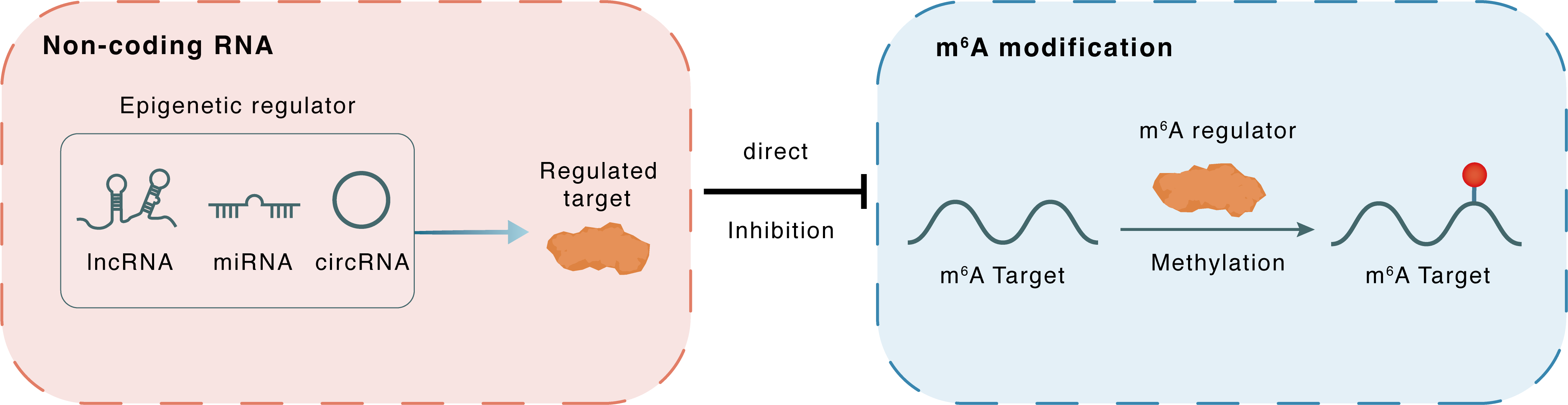 Non-coding RNA
FTO-IT1
RBM15
lncRNA miRNA circRNA
Direct
Inhibition
m6A modification
FAS
FAS
RBM15
Methylation
Non-coding RNA
FTO-IT1
RBM15
lncRNA miRNA circRNA
Direct
Inhibition
m6A modification
FAS
FAS
RBM15
Methylation
 : m6A sites : m6A sites
|
|||||
| m6A Modification: | |||||
|---|---|---|---|---|---|
| m6A Regulator | RNA-binding motif protein 15 (RBM15) | WRITER | |||
| m6A Target | Tumor necrosis factor receptor superfamily member 6 (FAS) | ||||
| Epigenetic Regulation that have Cross-talk with This m6A Modification: | |||||
| Epigenetic Regulation Type | Non-coding RNA (ncRNA) | ||||
| Epigenetic Regulator | FTO intronic transcript 1 (FTO-IT1) | LncRNA | View Details | ||
| Regulated Target | RNA binding motif protein 15 (RBM15) | View Details | |||
| Crosstalk Relationship | ncRNA → m6A | Inhibition | |||
| Crosstalk Mechanism | ncRNAs directly impacts m6A modification through recruiting m6A regulator | ||||
| Crosstalk Summary | m6A RIP-seq analysis revealed that FTO-IT1 knockout increased mRNA m6A methylation of a subset of p53 transcriptional target genes (e.g., Tumor necrosis factor receptor superfamily member 6 (FAS), TP53INP1, and SESN2) and induced PCa cell cycle arrest and apoptosis. FTO-IT1 directly binds RBM15 and inhibits RBM15 binding, m6A methylation, and stability of p53 target mRNAs. | ||||
In-vitro Model |
HEK293T | Normal | Homo sapiens | CVCL_0063 | |
| 22Rv1 | Prostate carcinoma | Homo sapiens | CVCL_1045 | ||
| LNCaP C4-2 | Prostate carcinoma | Homo sapiens | CVCL_4782 | ||
| PC-3 | Prostate carcinoma | Homo sapiens | CVCL_0035 | ||
| LNCaP | Prostate carcinoma | Homo sapiens | CVCL_0395 | ||
| LAPC-4 | Prostate carcinoma | Homo sapiens | CVCL_4744 | ||
| In-vivo Model | 5 × 10⁶ of mock KO or FTO-IT1 KO C4-2R cells were mixed with Matrigel (50 μ l of PBS plus 50 μ l of Matrigel (BD Biosciences)) and injected subcutaneously into mice. For 22Rv1 xenografts, 5 × 10⁶ of cells were mixed with Matrigel (50 μ l of PBS plus 50 μ l of Matrigel (BD Biosciences)) and injected subcutaneously into mice. | ||||
Full List of Potential Compound(s) Related to This m6A-centered Crosstalk
| Tumor necrosis factor receptor superfamily member 6 (FAS) | 8 Compound(s) Regulating the Target | Click to Show/Hide the Full List | ||
 Compound Name Compound Name |
VB-111 | Phase 3 | [2] | |
|---|---|---|---|---|
| MOA | Modulator | |||
| External Link | ||||
| Compound Name |
DE-098 | Phase 2 | [3] | |
| Synonyms |
ARG-098; Anti-Fas antibody, Santen; Anti-APO-1 antibody, Santen
Click to Show/Hide
|
|||
| External Link | ||||
| Compound Name |
APG-101 | Phase 2 | [4] | |
| Synonyms |
CD95 receptor extracellular domain-IgG fused protein (GvHD), Apogenix; CD95 receptor extracellular domain-IgG fused protein (myocardial infarction), Apogenix; CD95 receptor extracellular domain-IgG fused protein (stroke), Apogenix; CD95 receptor extracellular domain-immunoglobulin G fused protein (graft versus hostdisease), Apogenix
Click to Show/Hide
|
|||
| MOA | Inhibitor | |||
| External Link | ||||
| Compound Name |
APO-010 | Phase 1 | [5] | |
| Synonyms |
MegaFasL; Anticancer therapeutics (FasL), APoxis; Cancer therapeutics (FasL), Apoxis; Soluble FasL (Mega-Ligand), Apoxis; Soluble FasL (Mega-Ligand), TopoTarget
Click to Show/Hide
|
|||
| MOA | Binder | |||
| External Link | ||||
| Compound Name |
F61F12 | Investigative | [6] | |
| Synonyms |
Anti-Fas mAb (cancer), IMED
Click to Show/Hide
|
|||
| External Link | ||||
| Compound Name |
APG-103 | Investigative | [6] | |
| Synonyms |
CD95 receptor inhibitor (inflammatory disease), Apogenix
Click to Show/Hide
|
|||
| MOA | Inhibitor | |||
| External Link | ||||
| Compound Name |
2-aminophenoxazine-3-one | Investigative | [7] | |
| Synonyms |
Questiomycin A; 2-Amino-3H-phenoxazin-3-one; 2-Aminophenoxazin-3-one; 1916-59-2; 2-Aminophenoxazon; 2-Aminophenoxazone; 3-Aminophenoxazone; 2-Amino-3-phenoxazone; 3H-Phenoxazin-3-one, 2-amino-; Isophenoxazine; 2-amino-phenoxazin-3-one; NSC 94945; MLS000736964; CHEBI:17293; SMR000528446; BRN 0014215; Questinomycine A; 3H-Phenoxazin-3-one,2-amino-; AV toxin C; 2-Aminophenoxazinone; Phx-3 cpd; Phx-3; 2-amino-3-phenoxazinone; 2-azanylphenoxazin-3-one; Acrospermum viticola toxin C; NCIOpen2_006212; 4-27-00-05519 (Beilstein Handbook Reference); cid_72725; CHEMBL146710; SCHEMBL2609261; BDBM76155; DTXSID60172691; HMS2270F19; NSC94945; ZINC4095812; MFCD00207317; NSC-94945; 2-acetylamino-(3h)-phenoxazin-3-one; AKOS027339724; NCGC00246903-01; AS-47041; C02161; J-012388; BRD-K66640612-001-05-8; Q15424786
Click to Show/Hide
|
|||
| MOA | Activator | |||
| External Link | ||||
| Compound Name |
ISIS 17020 | Investigative | [8] | |
| External Link | ||||
References