
m6A-centered Crosstalk Information
Mechanism of Crosstalk between m6A Modification and Epigenetic Regulation
| Crosstalk ID |
M6ACROT05147
|
[1], [2] | |||
 Non-coding RNA
PCAT6
HNRNPA2B1
lncRNA miRNA circRNA
Direct
Enhancement
m6A modification
ATG4B
ATG4B
hnRNPA2B1
Non-coding RNA
PCAT6
HNRNPA2B1
lncRNA miRNA circRNA
Direct
Enhancement
m6A modification
ATG4B
ATG4B
hnRNPA2B1
 : m6A sites : m6A sites
|
|||||
| m6A Modification: | |||||
|---|---|---|---|---|---|
| m6A Regulator | Heterogeneous nuclear ribonucleoproteins A2/B1 (HNRNPA2B1) | READER | |||
| m6A Target | Cysteine protease ATG4B (ATG4B) | ||||
| Epigenetic Regulation that have Cross-talk with This m6A Modification: | |||||
| Epigenetic Regulation Type | Non-coding RNA (ncRNA) | ||||
| Epigenetic Regulator | Prostate cancer associated transcript 6 (PCAT6) | LncRNA | View Details | ||
| Regulated Target | Heterogeneous nuclear ribonucleoprotein A2/B1 (HNRNPA2B1) | View Details | |||
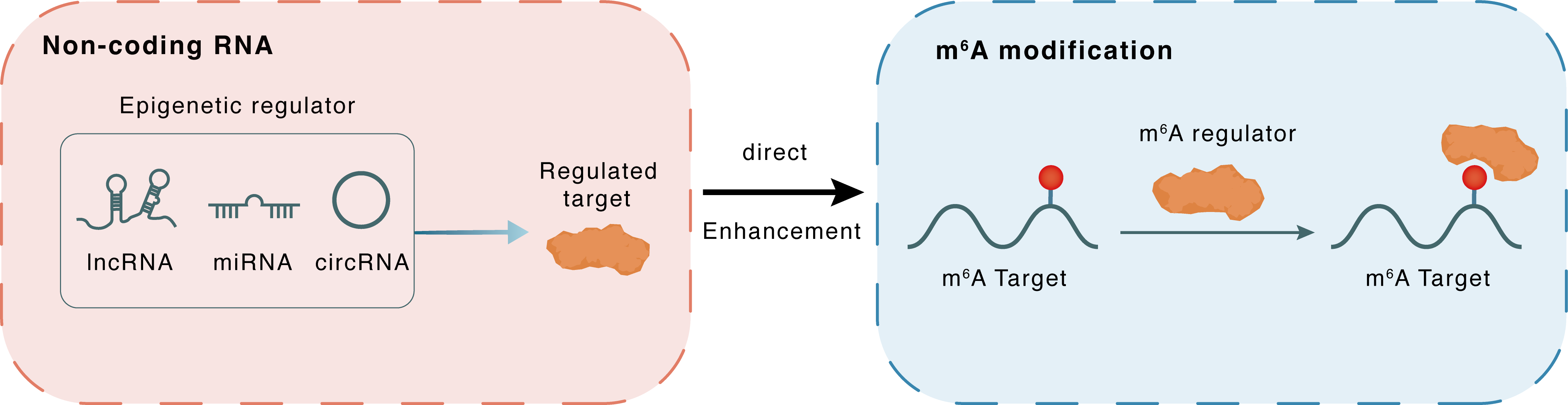
| Crosstalk Relationship | ncRNA → m6A | Enhancement | |||
| Crosstalk Mechanism | ncRNAs directly impacts m6A modification through recruiting m6A regulator | ||||
| Crosstalk Summary | Mechanically, PCAT6 functions as a scaffold between interferon-stimulated gene 15 (ISG15) and heterogeneous nuclear ribonucleoprotein A2/B1 (HNRNPA2B1), leading to ISGylation of hnRNPA2B1, thus protecting hnRNPA2B1 from ubiquitination-mediated proteasomal degradation.Overexpression of Cysteine protease ATG4B (ATG4B) rescued the malignancy driven by HNRNPA2B1 in breast cancer cells and increased the olaparib sensitivity. Our study revealed that the m6A reader HNRNPA2B1 mediated proliferation and autophagy in breast cancer cell lines by facilitating ATG4B mRNA decay and targeting HNRNPA2B1/m6A/ATG4B might enhance the olaparib sensitivity of breast cancer cells. | ||||
| Responsed Disease | Breast cancer | ICD-11: 2C60 | |||
| Responsed Drug | Olaparib | ||||
In-vitro Model |
MDA-MB-453 | Breast adenocarcinoma | Homo sapiens | CVCL_0418 | |
| MDA-MB-231 | Breast adenocarcinoma | Homo sapiens | CVCL_0062 | ||
| BT-549 | Invasive breast carcinoma | Homo sapiens | CVCL_1092 | ||
| BT-20 | Invasive breast carcinoma of no special type | Homo sapiens | CVCL_0178 | ||
| HCC1937 | Breast ductal carcinoma | Homo sapiens | CVCL_0290 | ||
| SK-BR-3 | Breast adenocarcinoma | Homo sapiens | CVCL_0033 | ||
| T-47D | Invasive breast carcinoma | Homo sapiens | CVCL_0553 | ||
| MCF-7 | Invasive breast carcinoma | Homo sapiens | CVCL_0031 | ||
| BT-474 | Invasive breast carcinoma | Homo sapiens | CVCL_0179 | ||
| MCF-10A | Normal | Homo sapiens | CVCL_0598 | ||
Full List of Potential Compound(s) Related to This m6A-centered Crosstalk
| 2C60: Breast cancer | 2 Compound(s) Regulating the Disease | Click to Show/Hide the Full List | ||
 Compound Name Compound Name |
Entrectinib | Approved | [3] | |
|---|---|---|---|---|
| Synonyms |
1108743-60-7; RXDX-101; UNII-L5ORF0AN1I; Entrectinib (RXDX-101); L5ORF0AN1I; Benzamide, N-[5-[(3,5-difluorophenyl)methyl]-1H-indazol-3-yl]-4-(4-methyl-1-piperazinyl)-2-[(tetrahydro-2H-pyran-4-yl)amino]-; Benzamide, N-(5-((3,5-difluorophenyl)methyl)-1H-indazol-3-yl)-4-(4-methyl-1-piperazinyl)-2-((tetrahydro-2H-pyran-4-yl)amino)-; Entrectinib [USAN:INN]; YMX; Kinome_2659; Entrectinib(rxdx-101); Entrectinib (USAN/INN); SCHEMBL3512601; GTPL8290; CHEMBL1983268; KS-00000TSK
Click to Show/Hide
|
|||
| External Link | ||||
| Compound Name |
Everolimus | Approved | [4] | |
| External Link | ||||
References