
m6A-centered Crosstalk Information
Mechanism of Crosstalk between m6A Modification and Epigenetic Regulation
| Crosstalk ID |
M6ACROT03375
|
[1], [2] | |||
 Histone modification
H3K18la
Epigenetic Regulator
AP001885.4
Indirect
Enhancement
m6A modification
hsa-miR-320b
hsa-miR-320b
METTL3
Methylation
Histone modification
H3K18la
Epigenetic Regulator
AP001885.4
Indirect
Enhancement
m6A modification
hsa-miR-320b
hsa-miR-320b
METTL3
Methylation
 : m6A sites : m6A sites
|
|||||
| m6A Modification: | |||||
|---|---|---|---|---|---|
| m6A Regulator | Methyltransferase-like 3 (METTL3) | WRITER | |||
| m6A Target | hsa-miR-320b | ||||
| Epigenetic Regulation that have Cross-talk with This m6A Modification: | |||||
| Epigenetic Regulation Type | Histone modification (HistMod) | ||||
| Regulated Target | Histone H3 lysine 18 lactylation (H3K18la) | View Details | |||
| Downstream Gene | AP001885.4 | View Details | |||
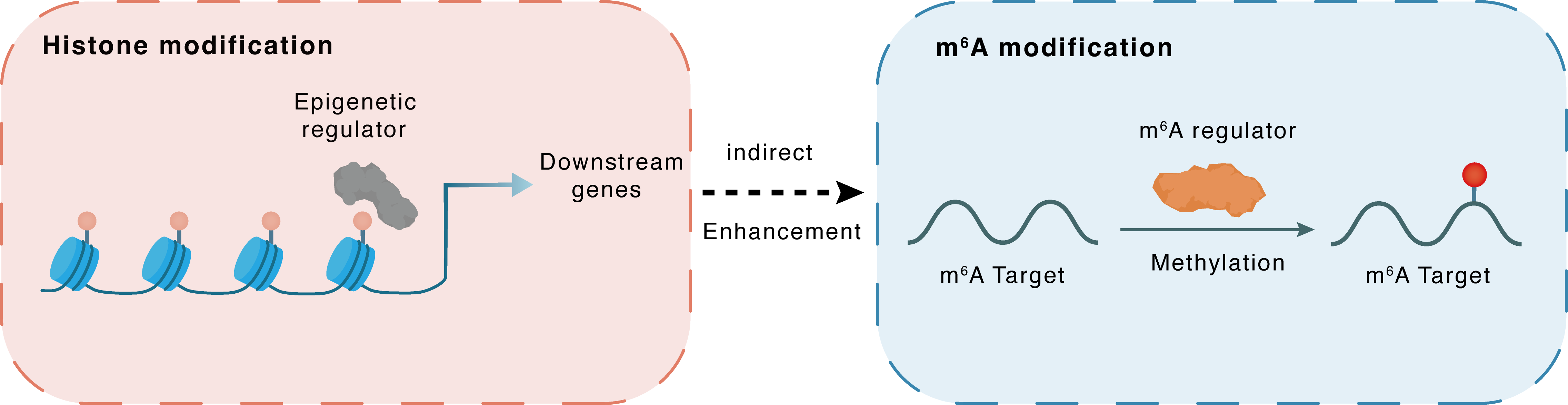
| Crosstalk Relationship | Histone modification → m6A | Enhancement | |||
| Crosstalk Mechanism | Histone modification indirectly regulates m6A modification through downstream signaling pathways | ||||
| Crosstalk Summary | AP001885.4 was overexpressed in ESCC cells because of a higher Histone H3 lysine 18 lactylation (H3K18la) level in the promoter and amplification, then enhanced histone lactylation- and NF-kappaB (p65)-dependent transcription activation and METTL3-mediated mRNA stability of c-myc eventually upregulated c-myc and promoted cell proliferation METTL3 could interact with DGCR8 protein and positively modulate pri-miR-320b maturation process in an N6-methyladenosine (m6A)-dependent manner. Therefore, our findings uncover a VEGF-C-independent mechanism of exosomal and intracellular hsa-miR-320b-mediated LN metastasis and identify miR-320b as a novel predictive marker and therapeutic target for LN metastasis in ESCC. | ||||
| Responsed Disease | Esophageal Squamous Cell Carcinoma | ICD-11: 2B70.1 | |||
| Cell Process | mRNA stability | ||||
| Cell proliferation | |||||
In-vitro Model |
KYSE-30 | Esophageal squamous cell carcinoma | Homo sapiens | CVCL_1351 | |
| KYSE-150 | Esophageal squamous cell carcinoma | Homo sapiens | CVCL_1348 | ||
| TE-1 | Esophageal squamous cell carcinoma | Homo sapiens | CVCL_1759 | ||
| Eca-109 | Esophageal squamous cell carcinoma | Homo sapiens | CVCL_6898 | ||
| CVCL_E307 | Esophageal squamous cell carcinoma | Homo sapiens | CVCL_E307 | ||
| HET-1A | Normal | Homo sapiens | CVCL_3702 | ||
| In-vivo Model | Luciferase-labeled KYSE150 cells (5 × 10⁶) were inoculated into the footpads of BALB/c nude mice (4-5 weeks old, 18-20 g) to establish the popliteal lymphatic metastasis model. | ||||
Full List of Potential Compound(s) Related to This m6A-centered Crosstalk
| 2B70: Esophageal cancer | 15 Compound(s) Regulating the Disease | Click to Show/Hide the Full List | ||
 Compound Name Compound Name |
Pembrolizumab | Approved | [3] | |
|---|---|---|---|---|
| External Link | ||||
| Compound Name |
Nivolumab | Approved | [3] | |
| External Link | ||||
| Compound Name |
Claudiximab | Phase 3 | [4] | |
| Synonyms |
IMAB-362; Anti-GC182 mAbs (cancer), Ganymed; Anti-GC182 monoclonal antibodies (cancer), Ganymed; Anti-CLDN18-2 mAbs (cancer), Ganymed; Anti-CLDN18-2 monoclonal antibodies (cancer), Ganymed
Click to Show/Hide
|
|||
| External Link | ||||
| Compound Name |
Golnerminogene pradenovac | Phase 3 | [5] | |
| Synonyms |
TNFerade (TN)
Click to Show/Hide
|
|||
| External Link | ||||
| Compound Name |
DKN-01 | Phase 2 | [6] | |
| External Link | ||||
| Compound Name |
Pegamotecan | Phase 2 | [7] | |
| Synonyms |
Prothecan; EZ-246; PEG-camptothecin; PEG-camptothecin, Enzon; Polyethylene glycol-camptothecin, Enzon
Click to Show/Hide
|
|||
| External Link | ||||
| Compound Name |
APR-246 | Phase 2 | [3] | |
| Synonyms |
Eprenetapopt
Click to Show/Hide
|
|||
| External Link | ||||
| Compound Name |
Opdivo + Yervoy | Phase 3 | [3] | |
| External Link | ||||
| Compound Name |
Anti-NY-ESO-1 CAR-T cells | Phase 1/2 | [8] | |
| External Link | ||||
| Compound Name |
Anti-MUC1 CAR-T cells | Phase 1/2 | [9] | |
| External Link | ||||
| Compound Name |
CAR-T Cells targeting EpCAM | Phase 1/2 | [10] | |
| External Link | ||||
| Compound Name |
PCA062 | Phase 1 | [3] | |
| External Link | ||||
| Compound Name |
Cellspan esophageal implant | Clinical trial | [3] | |
| External Link | ||||
| Compound Name |
PKI166 | Discontinued in Phase 2 | [11] | |
| Synonyms |
PKI-166; CGP-75166; 187724-61-4; NVP-PKI166; CHEMBL1914653; AC1OCFE0; UNII-9RIE5HW38P; 9RIE5HW38P; SCHEMBL177814; GTPL7642; CHEMBL1963502; ZINC23255; AOB1619; PKI-75166; BDBM50358046; NCGC00387215-02; AS-16676; KB-275097; PKI-166, > 4-[4-[[(1R)-1-phenylethyl]amino]-7H-pyrrolo[4,5-e]pyrimidin-6-yl]phenol
Click to Show/Hide
|
|||
| External Link | ||||
| Compound Name |
Ramorelix | Discontinued in Phase 1 | [12] | |
| Synonyms |
Hoe-013
Click to Show/Hide
|
|||
| External Link | ||||
References