
m6A-centered Crosstalk Information
Mechanism of Crosstalk between m6A Modification and Epigenetic Regulation
| Crosstalk ID |
M6ACROT02085
|
[1] | |||
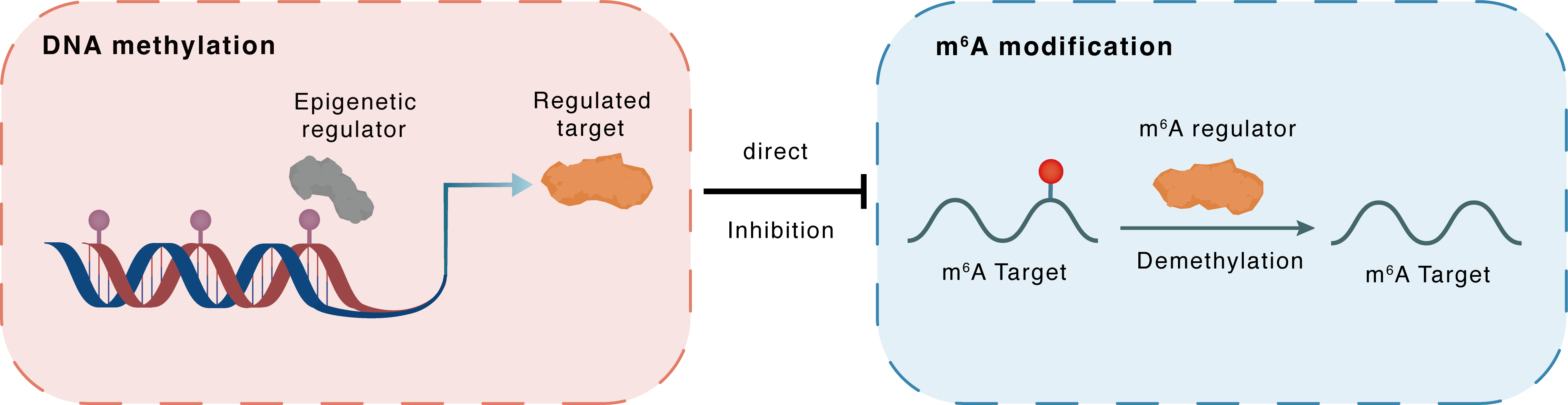 DNA methylation
DNMT3A
FTO
Direct
Inhibition
m6A modification
BDNF
BDNF
FTO
Demethylation
DNA methylation
DNMT3A
FTO
Direct
Inhibition
m6A modification
BDNF
BDNF
FTO
Demethylation
 : m6A sites : m6A sites
|
|||||
| m6A Modification: | |||||
|---|---|---|---|---|---|
| m6A Regulator | Fat mass and obesity-associated protein (FTO) | ERASER | |||
| m6A Target | Neurotrophic factor BDNF precursor form (BDNF) | ||||
| Epigenetic Regulation that have Cross-talk with This m6A Modification: | |||||
| Epigenetic Regulation Type | DNA methylation (DNAMeth) | ||||
| Epigenetic Regulator | Cysteine methyltransferase DNMT3A (DNMT3A) | WRITER | View Details | ||
| Regulated Target | FTO alpha-ketoglutarate dependent dioxygenase (FTO) | View Details | |||
| Crosstalk Relationship | DNA methylation → m6A | Inhibition | |||
| Crosstalk Mechanism | DNA methylation directly impacts m6A modification through modulating the expression level of m6A regulator | ||||
| Crosstalk Summary | A downregulation in demethylating enzyme Fto and upregulation in methylating enzyme Mettl3 were also noted. The FTO promoter was hypomethylated due to the lower expression of DNMT1 and DNMT3A and Nr3c1, Creb1, Ntrk2, Neurotrophic factor BDNF precursor form (BDNF) are downstream target genes of both METTL3 and FTO. | ||||
| Responsed Disease | Major depressive disorder | ICD-11: 6A70.3 | |||
In-vitro Model |
SH-SY5Y | Neuroblastoma | Homo sapiens | CVCL_0019 | |
| In-vivo Model | Rats were housed at 23 ° C and 55% humidity and were given ad libitum food and water. During acclimatization (1 week), rats were placed randomly (3/cage); however, after initial behavioral testing, they were grouped according to their behavioral phenotypes. All experiments were performed under a light cycle (8:00 AM and 10:00 AM). The protocol to induce LH behavior was approved by the Institutional Animal Care and Use Committee of the University of Alabama at Birmingham. The animal study also adhered to the international guidelines for the use and care of laboratory animals. | ||||
Full List of Potential Compound(s) Related to This m6A-centered Crosstalk
| Cysteine methyltransferase DNMT3A (DNMT3A) | 8 Compound(s) Regulating the Target | Click to Show/Hide the Full List | ||
 Compound Name Compound Name |
PMID27376512-Compound-Figure3CN | Patented | [2] | |
|---|---|---|---|---|
| MOA | Inhibitor | |||
| Activity | EC50 = 1100 nM | |||
| External Link | ||||
| Compound Name |
PMID27376512-Compound-Figure3CG | Patented | [2] | |
| MOA | Inhibitor | |||
| Activity | EC50 = 2400 nM | |||
| External Link | ||||
| Compound Name |
PMID27376512-Compound-Figure3CM | Patented | [2] | |
| MOA | Inhibitor | |||
| Activity | EC50 = 1100 nM | |||
| External Link | ||||
| Compound Name |
PMID27376512-Compound-Figure2aExample1 | Patented | [2] | |
| MOA | Inhibitor | |||
| Activity | IC50 = 3000 nM | |||
| External Link | ||||
| Compound Name |
PMID27376512-Compound-MTC-424 | Patented | [2] | |
| MOA | Inhibitor | |||
| Activity | IC50 = 1940 nM | |||
| External Link | ||||
| Compound Name |
PMID27376512-Compound-MTC-427 | Patented | [2] | |
| MOA | Inhibitor | |||
| Activity | IC50 = 295 nM | |||
| External Link | ||||
| Compound Name |
PMID27376512-Compound-MTC-422 | Patented | [2] | |
| MOA | Inhibitor | |||
| Activity | IC50 = 1430 nM | |||
| External Link | ||||
| Compound Name |
PMID27376512-Compound-MTC-423 | Patented | [2] | |
| MOA | Inhibitor | |||
| Activity | IC50 = 363 nM | |||
| External Link | ||||
| Neurotrophic factor BDNF precursor form (BDNF) | 1 Compound(s) Regulating the Target | Click to Show/Hide the Full List | ||
| Compound Name |
PYM-50028 | Phase 2 | [3] | |
| Synonyms |
Cogane; Smilagenin; P-58; P-63
Click to Show/Hide
|
|||
| MOA | Agonist | |||
| External Link | ||||
References