
m6A-centered Crosstalk Information
Mechanism of Crosstalk between m6A Modification and Epigenetic Regulation
| Crosstalk ID |
M6ACROT05970
|
[1] | |||
 m6A modification
LncRNA NORAD
LncRNA NORAD
YTHDF2
m6A modification
LncRNA NORAD
LncRNA NORAD
YTHDF2
 : m6A sites
Direct
Inhibition
Non-coding RNA
lncRNA NORAD
PUM1
lncRNA miRNA circRNA : m6A sites
Direct
Inhibition
Non-coding RNA
lncRNA NORAD
PUM1
lncRNA miRNA circRNA
|
|||||
| m6A Modification: | |||||
|---|---|---|---|---|---|
| m6A Regulator | YTH domain-containing family protein 2 (YTHDF2) | READER | |||
| m6A Target | Long intergenic non-protein coding RNA 657 (NORAD) | ||||
| Epigenetic Regulation that have Cross-talk with This m6A Modification: | |||||
| Epigenetic Regulation Type | Non-coding RNA (ncRNA) | ||||
| Epigenetic Regulator | Long intergenic non-protein coding RNA 657 (NORAD) | LncRNA | View Details | ||
| Regulated Target | Pumilio homolog 1 (PUM1) | View Details | |||
| Crosstalk Relationship | m6A → ncRNA | Inhibition | |||
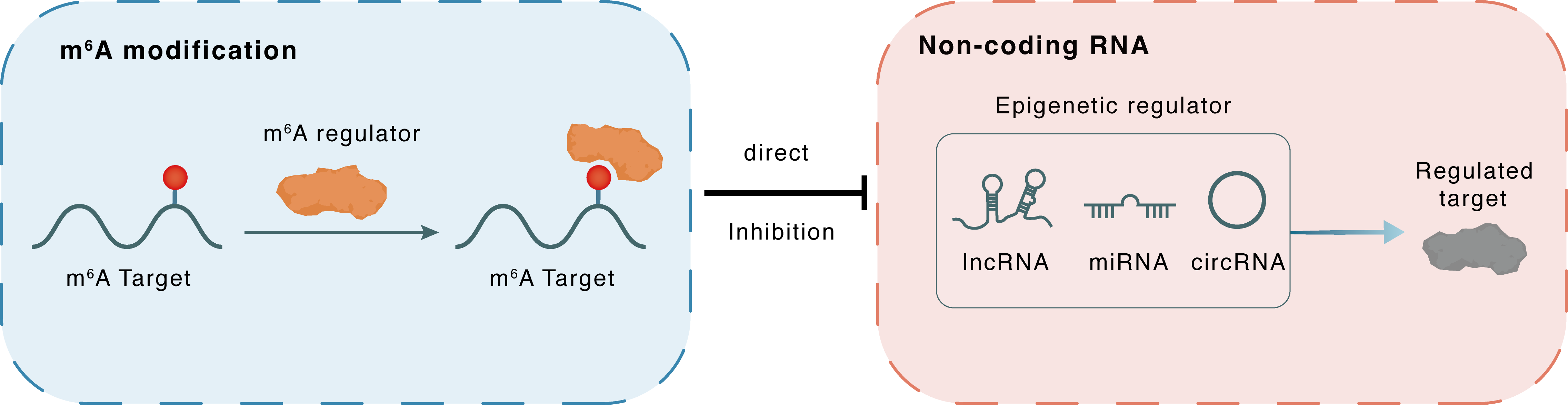
| Crosstalk Mechanism | m6A regulators directly modulate the functionality of ncRNAs through specific targeting ncRNA | ||||
| Crosstalk Summary | Subsequent loss- and gain-of-function experiments reveal WTAP is increased in senescent nucleus pulposus cells, and significantly promotes Long intergenic non-protein coding RNA 657 (NORAD) m6A modification. YTHDF2-mediated decay of NORAD is enhanced in senescent NPCs, and then deficiency of NORAD results in less sequestraion of PUMILIO proteins, contributing to the augmented activity of Pumilio homolog 1 (PUM1) and PUM2, thus repressing the expression of target E2F3 mRNAs and promoting the cellular senescence. This study shows interruption of NORAD m6A modification or the NORAD/PUMILIO/E2F3 axis could serve as a potential therapeutic target to inhibit the senescence of NPCs and development of intervertebral disc degeneration(IVDD). | ||||
| Responsed Disease | Intervertebral disc degeneration | ICD-11: FA80 | |||
In-vitro Model |
Nucleus pulposus cells (NPCs) (Nucleus pulposus cells) | ||||
| In-vivo Model | After 50g male NORAD-KO or C57 mice at age of 8 weeks were anesthetized with 3% (w/v) pentobarbital (2 ml/kg) and grouped randomly, investigators blinded to the group allocation performed the experiment. The disc levels in rat tail (Co6/7, 7/8, and 8/9) were located by palpation on the coccygeal vertebrae and confirmed by trial radiography. Needles (33-G) were used to puncture the annulus fibrosus layer though the tail skin, in parallel to the end plates. To ensure that the needle did not penetrate too deeply , the length of the needle was pre-determined according to the dimensions of annulus fibrosus and the NP , which were measured in a preliminary experiment and found to be approximately 4 mm. Five kinds of solution were prepared for intradisc injection, including AA V vector, AAV containing shPUM1, AAV containing shPUM2 for Norad KO mice, AAV vector, AAV containing shE2F3, AAVcontaining OE-E2F3 for WT mice. | ||||
Full List of Potential Compound(s) Related to This m6A-centered Crosstalk
| FA80: Intervertebral disc degeneration | 3 Compound(s) Regulating the Disease | Click to Show/Hide the Full List | ||
 Compound Name Compound Name |
Rexlemestrocel-L | Phase 3 | [2] | |
|---|---|---|---|---|
| Synonyms |
MPC-150-M
Click to Show/Hide
|
|||
| External Link | ||||
| Compound Name |
CybroCell | Phase 1/2 | [3] | |
| External Link | ||||
| Compound Name |
IDCT | Phase 1/2 | [4] | |
| Synonyms |
rebonuputemcel
Click to Show/Hide
|
|||
| External Link | ||||
References