
m6A-centered Crosstalk Information
Mechanism of Crosstalk between m6A Modification and Epigenetic Regulation
| Crosstalk ID |
M6ACROT05693
|
[1] | |||
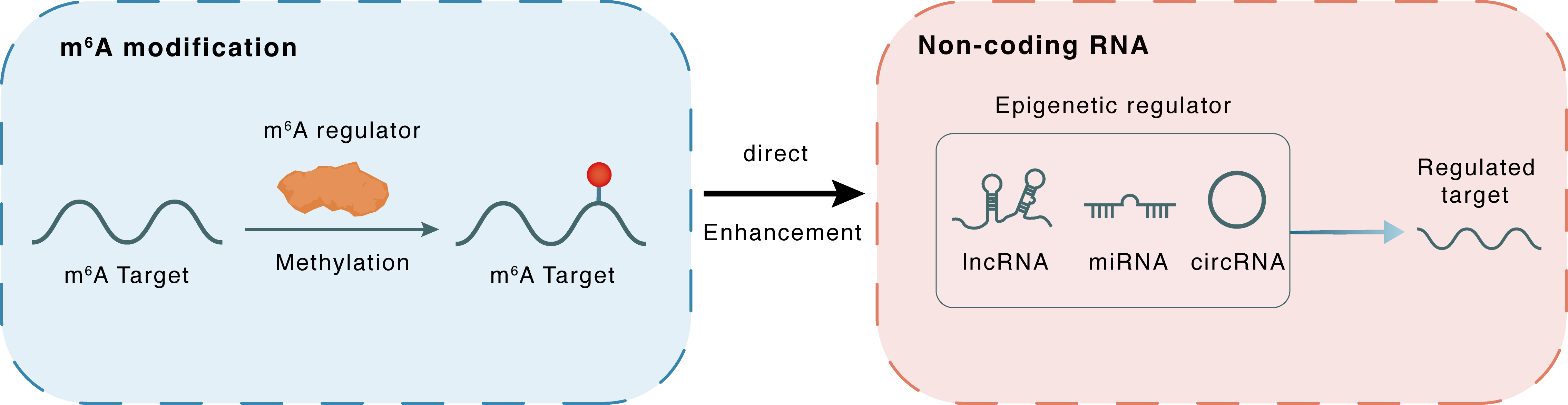 m6A modification
miR-148a-3p
miR-148a-3p
METTL3
Methylation
m6A modification
miR-148a-3p
miR-148a-3p
METTL3
Methylation
 : m6A sites
Direct
Enhancement
Non-coding RNA
miR-148a-3p
TXNIP
lncRNA miRNA circRNA : m6A sites
Direct
Enhancement
Non-coding RNA
miR-148a-3p
TXNIP
lncRNA miRNA circRNA
|
|||||
| m6A Modification: | |||||
|---|---|---|---|---|---|
| m6A Regulator | Methyltransferase-like 3 (METTL3) | WRITER | |||
| m6A Target | hsa-miR-148a-3p | ||||
| Epigenetic Regulation that have Cross-talk with This m6A Modification: | |||||
| Epigenetic Regulation Type | Non-coding RNA (ncRNA) | ||||
| Epigenetic Regulator | hsa-miR-148a-3p | microRNA | View Details | ||
| Regulated Target | Thioredoxin-interacting protein (TXNIP) | View Details | |||
| Crosstalk Relationship | m6A → ncRNA | Enhancement | |||
| Crosstalk Mechanism | m6A regulators directly modulate the functionality of ncRNAs through specific targeting ncRNA | ||||
| Crosstalk Summary | METTL3-mediated m6A modification of pri-hsa-miR-148a-3p affects prostate cancer progression by regulating Thioredoxin-interacting protein (TXNIP) | ||||
| Responsed Disease | Prostate cancer | ICD-11: 2C82 | |||
| Cell Process | Cell proliferation | ||||
| Cell migration | |||||
| Cell invasion | |||||
| Cell apoptosis | |||||
In-vitro Model |
RWPE-1 | Normal | Homo sapiens | CVCL_3791 | |
| LNCaP | Prostate carcinoma | Homo sapiens | CVCL_0395 | ||
| DU145 | Prostate carcinoma | Homo sapiens | CVCL_0105 | ||
| VCaP | Prostate carcinoma | Homo sapiens | CVCL_2235 | ||
| LAPC-4 | Prostate carcinoma | Homo sapiens | CVCL_4744 | ||
| In-vivo Model | Sixteen SPF female BALB/c nude mice (6 weeks old, weighing 20-22 g) (SLAC Laboratory Animal, Shanghai, China) were randomly arranged into the sh-NC group and the sh-METTL3 group, with 8 mice per group. After transfected with sh-NC and sh-METTL3, respectively, cells were rinsed with PBS to remove excess medium, detached with 0.25% trypsin, and detachment was terminated with complete medium, followed by centrifugation to collect cell precipitates. Appropriate amounts of physiological saline were added and gently pipetted into single-cell suspensions for cell counting. A total of 3 × 10⁶ cells were resuspended in 50 μL normal saline, mixed with 50 μL 25% Matrigel (1:1), and inoculated subcutaneously into the right inguinal of nude mice. Tumor growth curves were plotted with 7, 14, 21, and 28 days as time points, and the short diameter (a) and long diameter (b) of the tumor were determined using a vernier caliper to estimate the tumor volume V = (a2b)/2. Tumor mass was weighed on a scale. Following 4 weeks, nude mice were euthanized by an intraperitoneal injection of 150 mg/kg pentobarbital (P3761, Sigma). The skin near the tumor was cut short using surgical scissors, and the tumor was separated using ball pointed pliers. The tumors were partially embedded with paraffin for histological examination, and the remaining part was kept at 80°C. | ||||
Full List of Potential Compound(s) Related to This m6A-centered Crosstalk
| 2C82: Prostate cancer | 1 Compound(s) Regulating the Disease | Click to Show/Hide the Full List | ||
 Compound Name Compound Name |
CC-94676 | Phase 1 | [2] | |
|---|---|---|---|---|
| External Link | ||||
References