
m6A-centered Crosstalk Information
Mechanism of Crosstalk between m6A Modification and Epigenetic Regulation
| Crosstalk ID |
M6ACROT05468
|
[1] | |||
 m6A modification
KB-1980E6.3
KB-1980E6.3
IGF2BP1
m6A modification
KB-1980E6.3
KB-1980E6.3
IGF2BP1
 : m6A sites
Direct
Enhancement
Non-coding RNA
KB-1980E6.3
IGF2BP1
lncRNA miRNA circRNA : m6A sites
Direct
Enhancement
Non-coding RNA
KB-1980E6.3
IGF2BP1
lncRNA miRNA circRNA
|
|||||
| m6A Modification: | |||||
|---|---|---|---|---|---|
| m6A Regulator | Insulin-like growth factor 2 mRNA-binding protein 1 (IGF2BP1) | READER | |||
| m6A Target | KB-1980E6.3 | ||||
| Epigenetic Regulation that have Cross-talk with This m6A Modification: | |||||
| Epigenetic Regulation Type | Non-coding RNA (ncRNA) | ||||
| Epigenetic Regulator | KB-1980E6.3 | LncRNA | View Details | ||
| Regulated Target | Insulin like growth factor 2 mRNA binding protein 1 (IGF2BP1) | View Details | |||
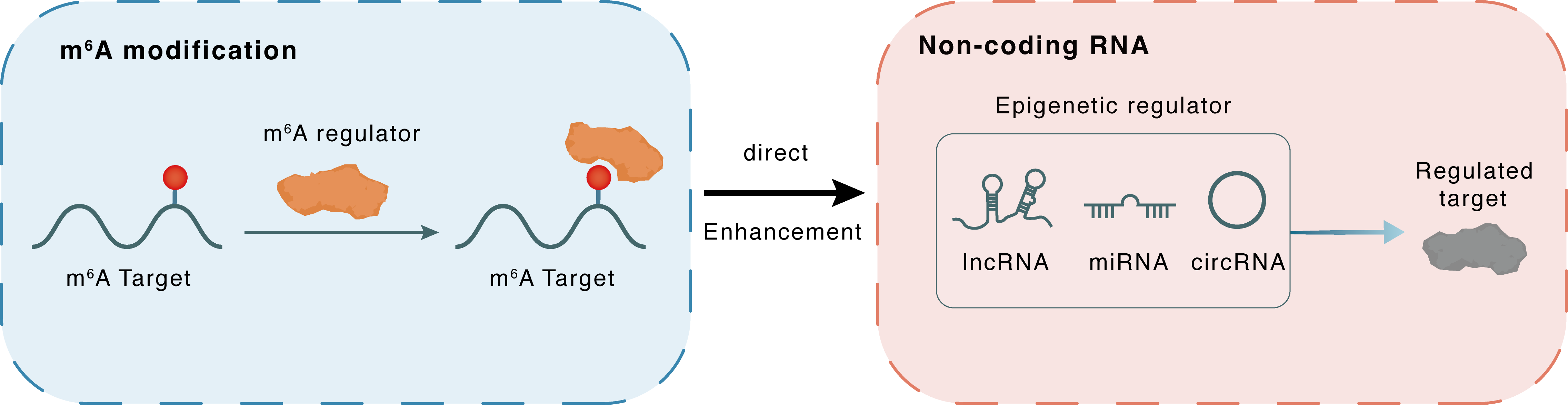
| Crosstalk Relationship | m6A → ncRNA | Enhancement | |||
| Crosstalk Mechanism | m6A regulators directly modulate the functionality of ncRNAs through specific targeting ncRNA | ||||
| Crosstalk Summary | Hypoxia-induced lncRNA KB-1980E6.3 is involved in the self-renewal and stemness maintenance of breast cancer stem cells by recruiting IGF2BP1 to regulate c-Myc mRNA stability. | ||||
| Responsed Disease | Breast cancer | ICD-11: 2C60 | |||
| Pathway Response | Signaling pathways regulating pluripotency of stem cells | hsa04550 | |||
In-vitro Model |
BT-549 | Invasive breast carcinoma | Homo sapiens | CVCL_1092 | |
| MDA-MB-231 | Breast adenocarcinoma | Homo sapiens | CVCL_0062 | ||
| MCF-7 | Invasive breast carcinoma | Homo sapiens | CVCL_0031 | ||
| Hs 578T | Invasive breast carcinoma | Homo sapiens | CVCL_0332 | ||
| T-47D | Invasive breast carcinoma | Homo sapiens | CVCL_0553 | ||
| MDA-MB-453 | Breast adenocarcinoma | Homo sapiens | CVCL_0418 | ||
| BT-474 | Invasive breast carcinoma | Homo sapiens | CVCL_0179 | ||
| MDA-MB-468 | Breast adenocarcinoma | Homo sapiens | CVCL_0419 | ||
| HEK293T | Normal | Homo sapiens | CVCL_0063 | ||
| In-vivo Model | The enriched mammosphere cells derived from engineered BT549 and Hs578T with silenced lncRNA KB-1980E6.3 (shKB/vector), BT549, and Hs578T with lncRNA KB-1980E6.3 knockdown combined with ectopic c-Myc (shKB/c-Myc), BT549, and Hs578T with silenced IGF2BP1 (shIGF2BP1/vector), BT549, and Hs578T with knocked down IGF2BP1 combined with ectopic c-Myc (shIGF2BP1/c-Myc), and BT549, and Hs578T/shNC/vector control cells were used in Xenograft experiments. Three doses (1 × 10⁵, 1 × 10⁴ and 1 × 10³) of spheres derived from the engineered Hs578T and 1 × 10⁵ of spheres derived from the engineered BT549 were subcutaneously inoculated into 4- to 6-week-old female nude mice (n = 5 per group). Mice were then treated with either bevacizumab (10 mg/kg every 3 days) to form a hypoxic tumor microenvironment or vehicle PBS to form a non-hypoxic condition. | ||||
Full List of Potential Compound(s) Related to This m6A-centered Crosstalk
| 2C60: Breast cancer | 2 Compound(s) Regulating the Disease | Click to Show/Hide the Full List | ||
 Compound Name Compound Name |
Entrectinib | Approved | [2] | |
|---|---|---|---|---|
| Synonyms |
1108743-60-7; RXDX-101; UNII-L5ORF0AN1I; Entrectinib (RXDX-101); L5ORF0AN1I; Benzamide, N-[5-[(3,5-difluorophenyl)methyl]-1H-indazol-3-yl]-4-(4-methyl-1-piperazinyl)-2-[(tetrahydro-2H-pyran-4-yl)amino]-; Benzamide, N-(5-((3,5-difluorophenyl)methyl)-1H-indazol-3-yl)-4-(4-methyl-1-piperazinyl)-2-((tetrahydro-2H-pyran-4-yl)amino)-; Entrectinib [USAN:INN]; YMX; Kinome_2659; Entrectinib(rxdx-101); Entrectinib (USAN/INN); SCHEMBL3512601; GTPL8290; CHEMBL1983268; KS-00000TSK
Click to Show/Hide
|
|||
| External Link | ||||
| Compound Name |
Everolimus | Approved | [3] | |
| External Link | ||||
References