
m6A-centered Crosstalk Information
Mechanism of Crosstalk between m6A Modification and Epigenetic Regulation
| Crosstalk ID |
M6ACROT05427
|
[1] | |||
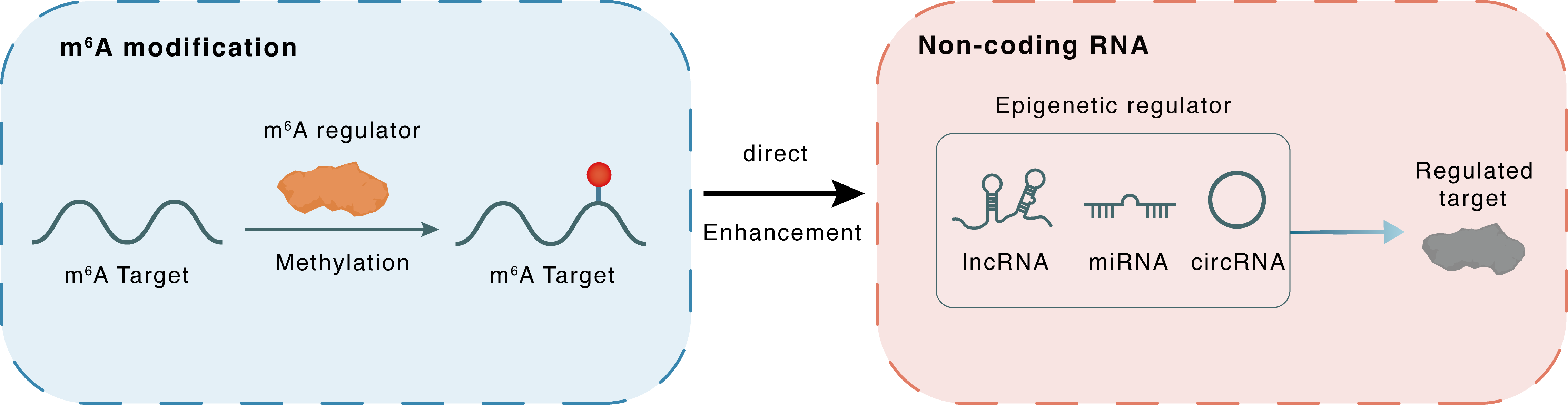 m6A modification
CCAT1
CCAT1
VIRMA
Methylation
m6A modification
CCAT1
CCAT1
VIRMA
Methylation
 : m6A sites
Direct
Enhancement
Non-coding RNA
CCAT1
MYC
lncRNA miRNA circRNA : m6A sites
Direct
Enhancement
Non-coding RNA
CCAT1
MYC
lncRNA miRNA circRNA
|
|||||
| m6A Modification: | |||||
|---|---|---|---|---|---|
| m6A Regulator | Protein virilizer homolog (VIRMA) | WRITER | |||
| m6A Target | Colon cancer associated transcript 1 (CCAT1) | ||||
| Epigenetic Regulation that have Cross-talk with This m6A Modification: | |||||
| Epigenetic Regulation Type | Non-coding RNA (ncRNA) | ||||
| Epigenetic Regulator | Colon cancer associated transcript 1 (CCAT1) | LncRNA | View Details | ||
| Regulated Target | Myc proto-oncogene protein (MYC) | View Details | |||
| Crosstalk Relationship | m6A → ncRNA | Enhancement | |||
| Crosstalk Mechanism | m6A regulators directly modulate the functionality of ncRNAs through specific targeting ncRNA | ||||
| Crosstalk Summary | VIRMA downregulation attenuates the aggressive phenotype of prostate cancer by overall reduction of m6A-levels decreasing stability and abundance of oncogenic lncRNAs. VIRMA depletion and m6A reduction decreased the stability and abundance of Colon cancer associated transcript 1 (CCAT1) transcripts. Stabilization of CCAT1/2 by m6A has an amplifying effect on Myc proto-oncogene protein (MYC) expression levels in cancer cells through both lncRNAs acting as super-enhancers that positively regulate MYC mRNA. | ||||
| Responsed Disease | Prostate cancer | ICD-11: 2C82 | |||
| Responsed Drug | Actinomycin D | ||||
| Cell Process | RNA stability | ||||
In-vitro Model |
22Rv1 | Prostate carcinoma | Homo sapiens | CVCL_1045 | |
| LNCaP | Prostate carcinoma | Homo sapiens | CVCL_0395 | ||
| VCaP | Prostate carcinoma | Homo sapiens | CVCL_2235 | ||
| DU145 | Prostate carcinoma | Homo sapiens | CVCL_0105 | ||
| PC-3 | Prostate carcinoma | Homo sapiens | CVCL_0035 | ||
Full List of Potential Compound(s) Related to This m6A-centered Crosstalk
| Myc proto-oncogene protein (MYC) | 3 Compound(s) Regulating the Target | Click to Show/Hide the Full List | ||
 Compound Name Compound Name |
AVI-5126 | Phase 2 | [2] | |
|---|---|---|---|---|
| Synonyms |
Resten-CP; NeuGene (CABG), AVI
Click to Show/Hide
|
|||
| External Link | ||||
| Compound Name |
Resten-NG | Phase 2 | [3] | |
| Synonyms |
Resten-NG (TN)
Click to Show/Hide
|
|||
| External Link | ||||
| Compound Name |
TWS-119 | Investigative | [4] | |
| Synonyms |
TWS119; 601514-19-6; 3-[[6-(3-Aminophenyl)-7H-pyrrolo[2,3-d]pyrimidin-4-yl]oxy]phenol; TWS 119; GSK inhibitor XII; GSK-3beta Inhibitor XII, TWS119; Neurogenesis Inducer, TWS119; CHEMBL405759; 3-(6-(3-aminophenyl)-7H-pyrrolo[2,3-d]pyrimidin-4-yloxy)phenol; 3-((6-(3-AMINOPHENYL)-7H-PYRROLO[2,3-D]PYRIMIDIN-4-YL)OXY)PHENOL; 3-{[6-(3-aminophenyl)-7H-pyrrolo[2,3-d]pyrimidin-4-yl]oxy}phenol; Phenol, 3-[[6-(3-aminophenyl)-1H-pyrrolo[2,3-d]pyrimidin-4-yl]oxy]-; K00245; MLS006011018; GTPL5980; SCHEMBL5559045; GSK-3BETA INHIB
Click to Show/Hide
|
|||
| External Link | ||||
| 2C82: Prostate cancer | 1 Compound(s) Regulating the Disease | Click to Show/Hide the Full List | ||
| Compound Name |
CC-94676 | Phase 1 | [5] | |
| External Link | ||||
References