
m6A-centered Crosstalk Information
Mechanism of Crosstalk between m6A Modification and Epigenetic Regulation
| Crosstalk ID |
M6ACROT05270
|
[1], [2] | |||
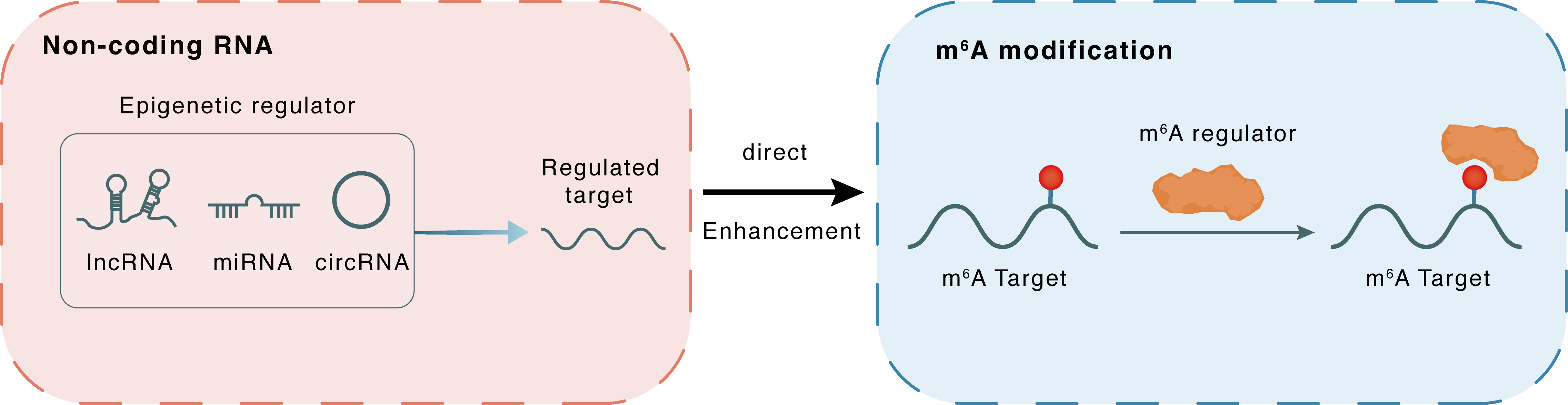 Non-coding RNA
miR-136-5p
YTHDF1
lncRNA miRNA circRNA
Direct
Enhancement
m6A modification
GID8
GID8
YTHDF1
Non-coding RNA
miR-136-5p
YTHDF1
lncRNA miRNA circRNA
Direct
Enhancement
m6A modification
GID8
GID8
YTHDF1
 : m6A sites : m6A sites
|
|||||
| m6A Modification: | |||||
|---|---|---|---|---|---|
| m6A Regulator | YTH domain-containing family protein 1 (YTHDF1) | READER | |||
| m6A Target | Glucose-induced degradation protein 8 homolog (GID8) | ||||
| Epigenetic Regulation that have Cross-talk with This m6A Modification: | |||||
| Epigenetic Regulation Type | Non-coding RNA (ncRNA) | ||||
| Epigenetic Regulator | hsa-miR-136-5p | microRNA | View Details | ||
| Regulated Target | YTH domain-containing family protein 1 (YTHDF1) | View Details | |||
| Crosstalk Relationship | ncRNA → m6A | Enhancement | |||
| Crosstalk Mechanism | ncRNAs directly impacts m6A modification through modulating the expression level of m6A regulator | ||||
| Crosstalk Summary | hsa-miR-136-5p targeted YTHDF1 to restrain CRC progression and chemoresistance.Glucose-induced degradation protein 8 homolog (GID8)/Twa1 as a crucial downstream target of YTHDF1. YTHDF1 manipulates GID8 translation efficiency in an m6A-dependent manner, and high expression of GID8 is associated with more aggressive tumor progression and poor overall survival.GID8 is intimately associated with glutamine metabolic demands by maintaining active glutamine uptake and metabolism through the regulation of excitatory amino acid transporter 1 (SLC1A3) and glutaminase (GLS), thereby facilitating the malignant progression of CRC. Inhibition of GID8 attenuated CRC proliferation and metastasis both in vitro and in vivo. | ||||
| Responsed Disease | Colorectal cancer | ICD-11: 2B91 | |||
In-vitro Model |
SW620 | Colon adenocarcinoma | Homo sapiens | CVCL_0547 | |
| HCT 116 | Colon carcinoma | Homo sapiens | CVCL_0291 | ||
| NCM460 | Normal | Homo sapiens | CVCL_0460 | ||
| HEK293T | Normal | Homo sapiens | CVCL_0063 | ||
| In-vivo Model | Sh-GID8 stable cells (2 × 10⁶) were inoculated subcutaneously into the left axilla of athymic nude mice (n = 5 mice/group). Every three days, the tumor's size was measured with a digital caliper, and its volume was computed using the following formula: tumor volume (mm3) = length × width × width × 0.52. When the subcutaneous tumor reached approximately 50-100 mm3, glutamine (75 mg/kg) [13] or PBS was injected intratumorally every day. Tumors were collected for TUNEL staining or other analysis when tumor volumes reached the humane endpoint. For the metastasis model, the constructed HCT116 cells (2 × 10⁶) with stable YTHDF1 or GID8 knockdown were injected into nude mice through the tail vein (n = 4 or n = 5 mice/group). Two months later, all the mice were sacrificed to observe tumor metastasis in the lungs. | ||||
Full List of Potential Compound(s) Related to This m6A-centered Crosstalk
| 2B91: Colorectal cancer | 25 Compound(s) Regulating the Disease | Click to Show/Hide the Full List | ||
 Compound Name Compound Name |
Retifanlimab | Approved | [3] | |
|---|---|---|---|---|
| Synonyms |
INCMGA0012; Retifanlimab
Click to Show/Hide
|
|||
| External Link | ||||
| Compound Name |
Aflibercept | Approved | [4] | |
| Synonyms |
Ziv-Aflibercept; Zaltrap (TN); VEGF Trap; VEGF Trap-Eye
Click to Show/Hide
|
|||
| External Link | ||||
| Compound Name |
Regorafenib | Approved | [5] | |
| Synonyms |
755037-03-7; BAY 73-4506; Regorafenibum; Stivarga; 4-(4-(3-(4-Chloro-3-(trifluoromethyl)phenyl)ureido)-3-fluorophenoxy)-N-methylpicolinamide; BAY73-4506; Regorafenib (BAY 73-4506); UNII-24T2A1DOYB; 4-[4-({[4-Chloro-3-(trifluoromethyl)phenyl]carbamoyl}amino)-3-fluorophenoxy]-N-methylpyridine-2-carboxamide; BAY-73-4506; 24T2A1DOYB; CHEMBL1946170; CHEBI:68647; Stivarga (TN); BAY73-4506 hydrochloride; Regorafenib [USAN:INN]
Click to Show/Hide
|
|||
| External Link | ||||
| Compound Name |
Bevacizumab | Approved | [6] | |
| Synonyms |
Bevacizumab (ophthalmic slow-release tissue tablet)
Click to Show/Hide
|
|||
| External Link | ||||
| Compound Name |
SYM-004 | Phase 3 | [6] | |
| Synonyms |
Chimeric IgG1 antibody 1024 (cancer), Symphogen; Chimeric IgG1 antibody 992 (cancer), Symphogen; Chimeric IgG1 antibodies992 + 1024 (cancer), Symphogen
Click to Show/Hide
|
|||
| External Link | ||||
| Compound Name |
Bevacizumab + Erlotinib | Phase 3 | [7] | |
| External Link | ||||
| Compound Name |
CPI-613 | Phase 3 | [6] | |
| Synonyms |
95809-78-2; 6,8-bis(benzylthio)octanoic acid; CPI 613; MLS006010202; SCHEMBL1062218; 6,8-Bis(benzylsulfanyl)octanoic acid; Octanoic acid, 6,8-bis((phenylmethyl)thio)-; Octanoic acid, 6,8-bis[(phenylMethyl)thio]-; 6,8-Bis[(phenylmethyl)thio]octanoic acid; CPI613; CHEMBL3186849; QCR-193; AOB1058; MolPort-023-219-128; HMS3656L06; C22H28O2S2; BCP04663; EX-A2043; s2776; AKOS025142095; BCP9000552; DB12109; RL06062; CS-0961; NCGC00344764-01; SMR004701300; AS-16613; BC261916; AK174899; HY-15453; BCP0726000030; KB-293127; AB0035874
Click to Show/Hide
|
|||
| External Link | ||||
| Compound Name |
Bevacizumab | Approved | [4] | |
| External Link | ||||
| Compound Name |
AlloStim | Phase 2/3 | [8] | |
| Synonyms |
AlloStim (TN)
Click to Show/Hide
|
|||
| External Link | ||||
| Compound Name |
Sibrotuzumab | Phase 2 | [9] | |
| External Link | ||||
| Compound Name |
CV301 | Phase 2 | [10] | |
| External Link | ||||
| Compound Name |
Efatutazone | Phase 2 | [11] | |
| Synonyms |
Inolitazone; 223132-37-4; 5-[[4-[[6-(4-amino-3,5-dimethylphenoxy)-1-methyl-1H-benzimidazol-2-yl]methoxy]phenyl]methyl]-2,4-Thiazolidinedione; Efatutazone [INN]; RS5444; CS-7017; SCHEMBL3246054; CHEMBL3545280; JCYNMRJCUYVDBC-UHFFFAOYSA-N; Efatutazone;CS-7017;RS5444; BCP07478; AKOS030526729; DB11894; CS-0778; KB-77905; DA-07988; HY-14792; QC-10456; 4CA-1384; FT-0737589; 5-[4-[6-(4-amino-3 ,5-dimethylphenoxy)-1-methyl-1H-benzimidazol-2-ylmethoxy]benzyl]thiazolidine-2,4-dione
Click to Show/Hide
|
|||
| External Link | ||||
| Compound Name |
LOR-2040 | Phase 2 | [12] | |
| External Link | ||||
| Compound Name |
RG7221 | Phase 2 | [13] | |
| External Link | ||||
| Compound Name |
PEG-SN38 | Phase 2 | [14] | |
| Synonyms |
EZN-2208
Click to Show/Hide
|
|||
| External Link | ||||
| Compound Name |
MEGF0444A | Phase 2 | [15] | |
| External Link | ||||
| Compound Name |
Encapsulated cell therapy | Phase 1/2 | [16] | |
| External Link | ||||
| Compound Name |
AB928 | Phase 1/2 | [17] | |
| External Link | ||||
| Compound Name |
MGD007 | Phase 1 | [13] | |
| External Link | ||||
| Compound Name |
BNC-101 | Phase 1 | [18] | |
| External Link | ||||
| Compound Name |
Navicixizumab | Phase 1 | [6] | |
| External Link | ||||
| Compound Name |
RG7160 | Discontinued in Phase 2 | [19] | |
| External Link | ||||
| Compound Name |
Nimesulide | Terminated | [20] | |
| Synonyms |
51803-78-2; N-(4-Nitro-2-phenoxyphenyl)methanesulfonamide; Mesulid; Flogovital; Sulidene; Nimed; R-805; 4-NITRO-2-PHENOXYMETHANESULFONANILIDE; Nisulid; Nimesulidum [INN-Latin]; Nimesulida [INN-Spanish]; R 805; UNII-V4TKW1454M; 4-Nitro-2-phenoxy-methanesulfonanilide; 4'-Nitro-2'-phenoxymethanesulfonanilide; Methanesulfonamide, N-(4-nitro-2-phenoxyphenyl)-; EINECS 257-431-4; 4'-Nitro-2'-phenoxymethansulfonanilid; BRN 2421175; CHEMBL56367; MLS000069680; V4TKW1454M; Methanesulfonanilide, 4'-nitro-2'-phenoxy-; CHEBI:44445; Dulanermin
Click to Show/Hide
|
|||
| External Link | ||||
| Compound Name |
Saracatinib | Phase 2 | [21] | |
| External Link | ||||
| Compound Name |
G3139 + Irinotecan | Investigative | [22] | |
| External Link | ||||
References