
m6A-centered Crosstalk Information
Mechanism of Crosstalk between m6A Modification and Epigenetic Regulation
| Crosstalk ID |
M6ACROT05132
|
[1], [2] | |||
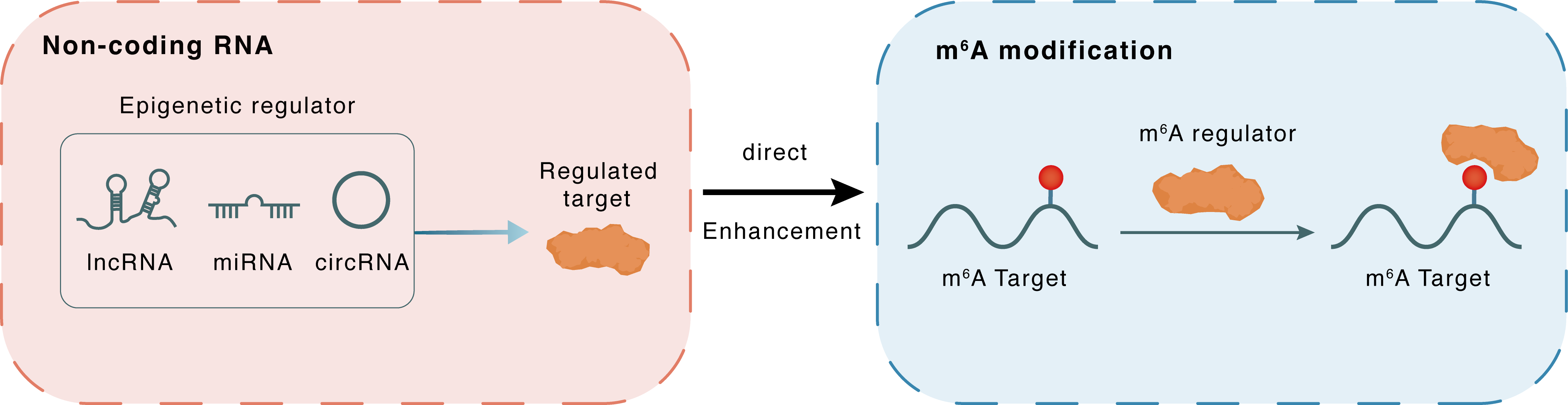 Non-coding RNA
PCAT6
HNRNPA2B1
lncRNA miRNA circRNA
Direct
Enhancement
m6A modification
hsa-miR-1266-5p
hsa-miR-1266-5p
hnRNPA2B1
Non-coding RNA
PCAT6
HNRNPA2B1
lncRNA miRNA circRNA
Direct
Enhancement
m6A modification
hsa-miR-1266-5p
hsa-miR-1266-5p
hnRNPA2B1
 : m6A sites : m6A sites
|
|||||
| m6A Modification: | |||||
|---|---|---|---|---|---|
| m6A Regulator | Heterogeneous nuclear ribonucleoproteins A2/B1 (HNRNPA2B1) | READER | |||
| m6A Target | hsa-miR-1266-5p | ||||
| Epigenetic Regulation that have Cross-talk with This m6A Modification: | |||||
| Epigenetic Regulation Type | Non-coding RNA (ncRNA) | ||||
| Epigenetic Regulator | Prostate cancer associated transcript 6 (PCAT6) | LncRNA | View Details | ||
| Regulated Target | Heterogeneous nuclear ribonucleoprotein A2/B1 (HNRNPA2B1) | View Details | |||
| Crosstalk Relationship | ncRNA → m6A | Enhancement | |||
| Crosstalk Mechanism | ncRNAs directly impacts m6A modification through recruiting m6A regulator | ||||
| Crosstalk Summary | Mechanically, PCAT6 functions as a scaffold between interferon-stimulated gene 15 (ISG15) and heterogeneous nuclear ribonucleoprotein A2/B1 (HNRNPA2B1), leading to ISGylation of hnRNPA2B1, thus protecting hnRNPA2B1 from ubiquitination-mediated proteasomal degradation.HNRNPA2B1 is a reader of the N(6)-methyladenosine mark in primary-miRNAs and promotes DROSHA processing to precursor-miRNAs. HNRNPA2B1 downregulated hsa-miR-29a-3p, miR-29b-3p, and miR-222 and upregulated hsa-miR-1266-5p, miR-1268a, miR-671-3p. Transient overexpression of HNRNPA2/B1 reduced breast cancer cellMCF-7 sensitivity to 4-hydroxytamoxifen and fulvestrant, suggesting a role for HNRNPA2/B1 in endocrine-resistance. | ||||
| Responsed Disease | Breast cancer | ICD-11: 2C60 | |||
| Responsed Drug | Fulvestrant | ||||
| Pathway Response | TGF-beta signaling pathway | hsa04350 | |||
| Cell Process | Endocrine-resistance | ||||
In-vitro Model |
MCF-7 | Invasive breast carcinoma | Homo sapiens | CVCL_0031 | |
| MCF7/LCC9 | Invasive breast carcinoma | Homo sapiens | CVCL_DP52 | ||
Full List of Potential Compound(s) Related to This m6A-centered Crosstalk
| 2C60: Breast cancer | 2 Compound(s) Regulating the Disease | Click to Show/Hide the Full List | ||
 Compound Name Compound Name |
Entrectinib | Approved | [3] | |
|---|---|---|---|---|
| Synonyms |
1108743-60-7; RXDX-101; UNII-L5ORF0AN1I; Entrectinib (RXDX-101); L5ORF0AN1I; Benzamide, N-[5-[(3,5-difluorophenyl)methyl]-1H-indazol-3-yl]-4-(4-methyl-1-piperazinyl)-2-[(tetrahydro-2H-pyran-4-yl)amino]-; Benzamide, N-(5-((3,5-difluorophenyl)methyl)-1H-indazol-3-yl)-4-(4-methyl-1-piperazinyl)-2-((tetrahydro-2H-pyran-4-yl)amino)-; Entrectinib [USAN:INN]; YMX; Kinome_2659; Entrectinib(rxdx-101); Entrectinib (USAN/INN); SCHEMBL3512601; GTPL8290; CHEMBL1983268; KS-00000TSK
Click to Show/Hide
|
|||
| External Link | ||||
| Compound Name |
Everolimus | Approved | [4] | |
| External Link | ||||
References