
m6A-centered Crosstalk Information
Mechanism of Crosstalk between m6A Modification and Epigenetic Regulation
| Crosstalk ID |
M6ACROT05016
|
[1], [2] | |||
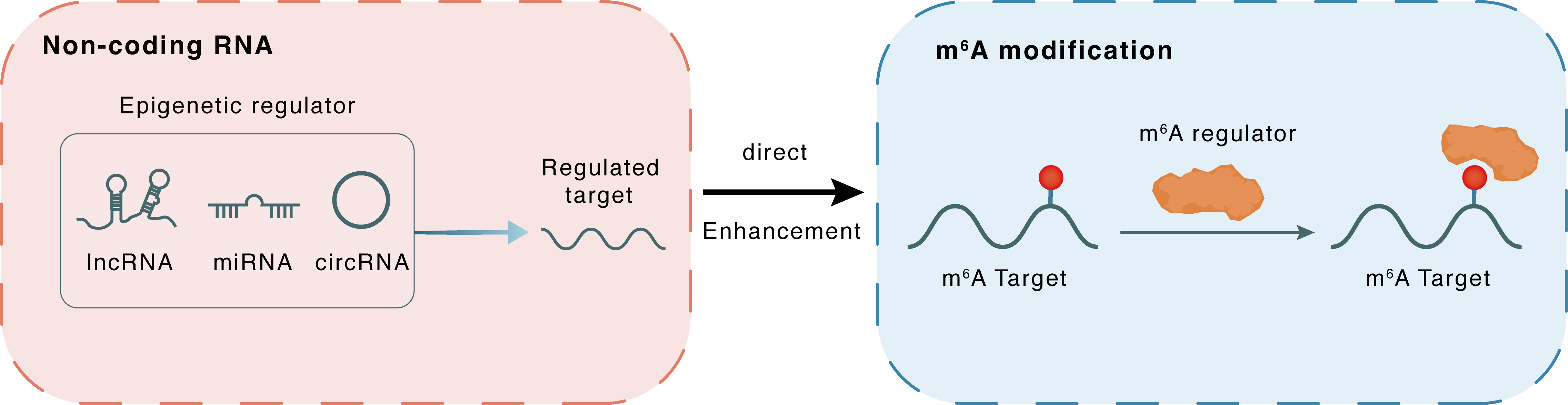 Non-coding RNA
DARS-AS1
IGF2BP3
lncRNA miRNA circRNA
Direct
Enhancement
m6A modification
ACIN1
ACIN1
IGF2BP3
Non-coding RNA
DARS-AS1
IGF2BP3
lncRNA miRNA circRNA
Direct
Enhancement
m6A modification
ACIN1
ACIN1
IGF2BP3
 : m6A sites : m6A sites
|
|||||
| m6A Modification: | |||||
|---|---|---|---|---|---|
| m6A Regulator | Insulin-like growth factor 2 mRNA-binding protein 3 (IGF2BP3) | READER | |||
| m6A Target | Apoptotic chromatin condensation inducer in the nucleus (ACIN1) | ||||
| Epigenetic Regulation that have Cross-talk with This m6A Modification: | |||||
| Epigenetic Regulation Type | Non-coding RNA (ncRNA) | ||||
| Epigenetic Regulator | DARS1 antisense RNA 1 (DARS1-AS1) | LncRNA | View Details | ||
| Regulated Target | Insulin like growth factor 2 mRNA binding protein 3 (IGF2BP3) | View Details | |||
| Crosstalk Relationship | ncRNA → m6A | Enhancement | |||
| Crosstalk Mechanism | ncRNAs directly impacts m6A modification through modulating the expression level of m6A regulator | ||||
| Crosstalk Summary | Downregulation of LncRNA DARS1-AS1 Inhibits the Tumorigenesis of Cervical Cancer via Inhibition of IGF2BP3, METTL3 interacts with IGF2BP3 to promote the mRNA stability of Apoptotic chromatin condensation inducer in the nucleus (ACIN1), the overexpression of which induces the aggressiveness of CC cells. | ||||
| Responsed Disease | Cervical cancer | ICD-11: 2C77 | |||
| Pathway Response | mRNA surveillance pathway | hsa03015 | |||
| RNA degradation | hsa03018 | ||||
| Cell Process | RNA stability | ||||
In-vitro Model |
SiHa | Cervical squamous cell carcinoma | Homo sapiens | CVCL_0032 | |
| HeLa | Endocervical adenocarcinoma | Homo sapiens | CVCL_0030 | ||
| In-vivo Model | 2 × 10⁶ stably transfected HeLa cells were subcutaneously inoculated into the left flank of mice. | ||||
References