
m6A-centered Crosstalk Information
Mechanism of Crosstalk between m6A Modification and Epigenetic Regulation
| Crosstalk ID |
M6ACROT03405
|
[1], [2] | |||
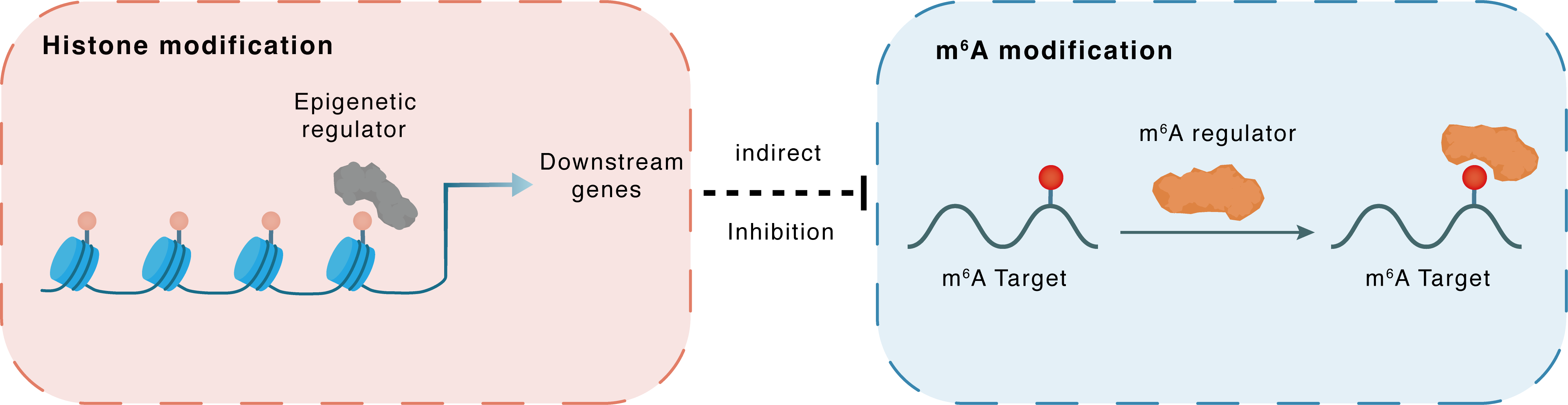 Histone modification
H3K27ac
p300
ALKBH5
Indirect
Inhibition
m6A modification
GAS5
GAS5
YTHDF2
Histone modification
H3K27ac
p300
ALKBH5
Indirect
Inhibition
m6A modification
GAS5
GAS5
YTHDF2
 : m6A sites : m6A sites
|
|||||
| m6A Modification: | |||||
|---|---|---|---|---|---|
| m6A Regulator | YTH domain-containing family protein 2 (YTHDF2) | READER | |||
| m6A Target | Growth arrest specific 5 (GAS5) | ||||
| Epigenetic Regulation that have Cross-talk with This m6A Modification: | |||||
| Epigenetic Regulation Type | Histone modification (HistMod) | ||||
| Epigenetic Regulator | Histone acetyltransferase p300 (P300) | WRITER | View Details | ||
| Regulated Target | Histone H3 lysine 27 acetylation (H3K27ac) | View Details | |||
| Downstream Gene | ALKBH5 | View Details | |||
| Crosstalk Relationship | Histone modification → m6A | Inhibition | |||
| Crosstalk Mechanism | histone modification indirectly regulates m6A modification through downstream signaling pathways | ||||
| Crosstalk Summary | E7 increased ALKBH5 expression through p300-mediated activation of the Histone H3 lysine 4 trimethylation (H3K4me3), as well as post-translational modification mediated by DDX3. ALKBH5-mediated m6A demethylation enhanced the expression of PAK5. The m6A reader YTHDF2 bound to PAK5 mRNA and regulated its stability in an m6A-dependent manner.The GAS5-AS1 expression in cervical cancer tissues was markedly decreased when compared with that in the adjacent normal tissues. GAS5-AS1 interacted with the tumor suppressor Growth arrest specific 5 (GAS5), and increased its stability by interacting with RNA demethylase ALKBH5 and decreasing GAS5 N6-methyladenosine (m6A) modification. m6A-mediated GAS5 RNA degradation relied on the m6A reader protein YTHDF2-dependent pathway. | ||||
| Responsed Disease | Cervical cancer | ICD-11: 2C77 | |||
| Cell Process | Cell proliferation and metastasis | ||||
In-vitro Model |
Ca Ski | Cervical squamous cell carcinoma | Homo sapiens | CVCL_1100 | |
| SiHa | Cervical squamous cell carcinoma | Homo sapiens | CVCL_0032 | ||
| C-33 A | Cervical squamous cell carcinoma | Homo sapiens | CVCL_1094 | ||
| HeLa | Endocervical adenocarcinoma | Homo sapiens | CVCL_0030 | ||
| In-vivo Model | 200 uL PBS containing 1× 10⁷ cells of stable cells were subcutaneously injected into male BALB/c athymic nude mice (6-week old, 18-20 g). | ||||
Full List of Potential Compound(s) Related to This m6A-centered Crosstalk
| Histone acetyltransferase p300 (P300) | 2 Compound(s) Regulating the Target | Click to Show/Hide the Full List | ||
 Compound Name Compound Name |
CCS1477 | Phase 1/2 | [3] | |
|---|---|---|---|---|
| Synonyms |
CCS-1477; CBP-IN-1; 2222941-37-7; (S)-1-(3,4-Difluorophenyl)-6-(5-(3,5-dimethylisoxazol-4-yl)-1-((1r,4S)-4-methoxycyclohexyl)-1H-benzo[d]imidazol-2-yl)piperidin-2-one; SCHEMBL20094038; SCHEMBL21515367; SCHEMBL22134021; EX-A3687; NSC818619; NSC-818619; HY-111784; CS-0091862; (S)-1-(3,4-Difluorophenyl)-6-(5-(3,5-dimethylisoxazol-4-yl)-1-(trans-4-methoxycyclohexyl)-1H-benzo[d]imidazol-2-yl)piperidin-2-one
Click to Show/Hide
|
|||
| MOA | Inhibitor | |||
| External Link | ||||
| Compound Name |
FT-7051 | Phase 1 | [4] | |
| MOA | Inhibitor | |||
| External Link | ||||
References