
m6A-centered Crosstalk Information
Mechanism of Crosstalk between m6A Modification and Epigenetic Regulation
| Crosstalk ID |
M6ACROT03162
|
[1] | |||
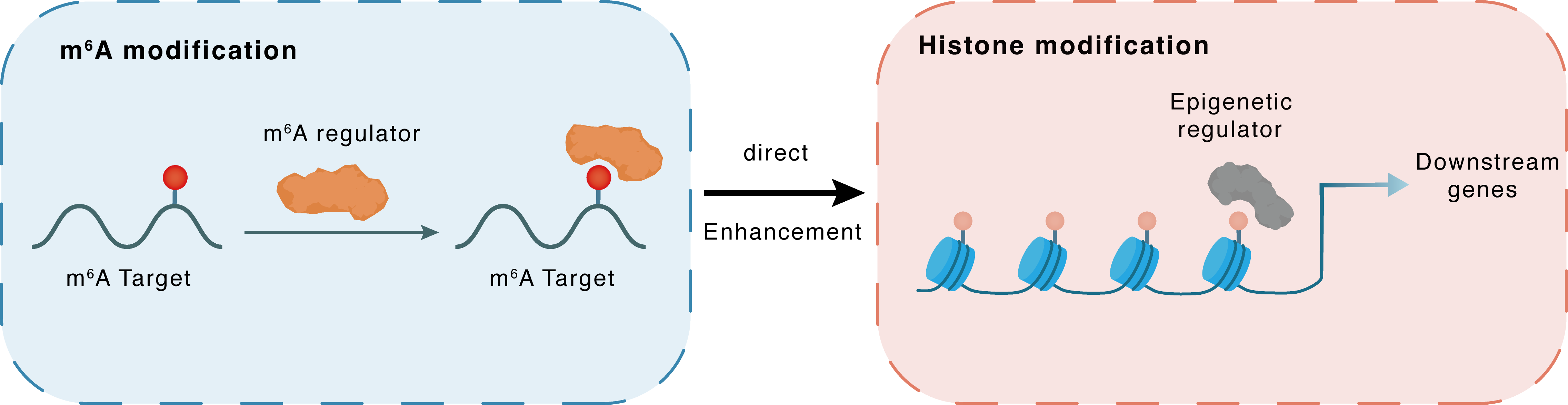 m6A modification
KMT2C
KMT2C
YTHDC1
m6A modification
KMT2C
KMT2C
YTHDC1
 : m6A sites
Direct
Enhancement
Histone modification
H3K4me1
KMT2C
BRCA1 : m6A sites
Direct
Enhancement
Histone modification
H3K4me1
KMT2C
BRCA1
|
|||||
| m6A Modification: | |||||
|---|---|---|---|---|---|
| m6A Regulator | YTH domain-containing protein 1 (YTHDC1) | READER | |||
| m6A Target | Histone-lysine N-methyltransferase 2C (KMT2C) | ||||
| Epigenetic Regulation that have Cross-talk with This m6A Modification: | |||||
| Epigenetic Regulation Type | Histone modification (HistMod) | ||||
| Epigenetic Regulator | Histone-lysine N-methyltransferase 2C (KMT2C) | WRITER | View Details | ||
| Regulated Target | Histone H3 lysine 4 monomethylation (H3K4me1) | View Details | |||
| Downstream Gene | BRCA1 | View Details | |||
| Crosstalk Relationship | m6A → Histone modification | Enhancement | |||
| Crosstalk Mechanism | m6A modification impacts directly histone modification through modulating the expression level of histone-associated enzymes | ||||
| Crosstalk Summary | YTHDC1 is a therapeutic target for B-cell acute lymphoblastic leukemia by attenuating DNA damage response through the Histone-lysine N-methyltransferase 2C (KMT2C)-Histone H3 lysine 4 monomethylation (H3K4me1)/H3K4me3 epigenetic axis. BRCA1 is a downstream gene of H3K4me1. | ||||
| Responsed Disease | B-cell acute lymphoblastic leukemia | ICD-11: XH8NN2 | |||
In-vitro Model |
NALM-6 | Adult B acute lymphoblastic leukemia | Homo sapiens | CVCL_0092 | |
| KOPN-8 | Childhood B acute lymphoblastic leukemia | Homo sapiens | CVCL_1866 | ||
| SUP-B15 | B-lymphoblastic leukemia | Homo sapiens | CVCL_0103 | ||
| BALL-1 | Adult B acute lymphoblastic leukemia | Homo sapiens | CVCL_1075 | ||
| In-vivo Model | NCG mice were inoculated through the tail vein (day 0) with 0.5 × 10⁶ luciferase-expressing NALM-6 cells, 1 × 10⁶ luciferase-expressing RS4; 11 cells, or 1 × 10⁶ patient-derived B-ALL cells infected with lentivirus expressing shCtrl or shDC1. For EPZ-5676 treatment in vivo, eight-weeks-old female NCG mice were inoculated through the tail vein (day 0) with 0.5 × 10⁶ YTHDC1-overexpressing NALM-6 (DC1highNALM-6) cells or 1 × 10⁶ YTHDC1-overexpressing RS4; 11 (DC1highRS4; 11) cells. | ||||