
m6A-centered Crosstalk Information
Mechanism of Crosstalk between m6A Modification and Epigenetic Regulation
| Crosstalk ID |
M6ACROT03048
|
[1] | |||
 Histone modification
H3K18la
LDHB
YTHDF2
Direct
Enhancement
m6A modification
PER1
PER1
YTHDF2
Histone modification
H3K18la
LDHB
YTHDF2
Direct
Enhancement
m6A modification
PER1
PER1
YTHDF2
 : m6A sites : m6A sites
|
|||||
| m6A Modification: | |||||
|---|---|---|---|---|---|
| m6A Regulator | YTH domain-containing family protein 2 (YTHDF2) | READER | |||
| m6A Target | Period circadian protein homolog 1 (PER1) | ||||
| Epigenetic Regulation that have Cross-talk with This m6A Modification: | |||||
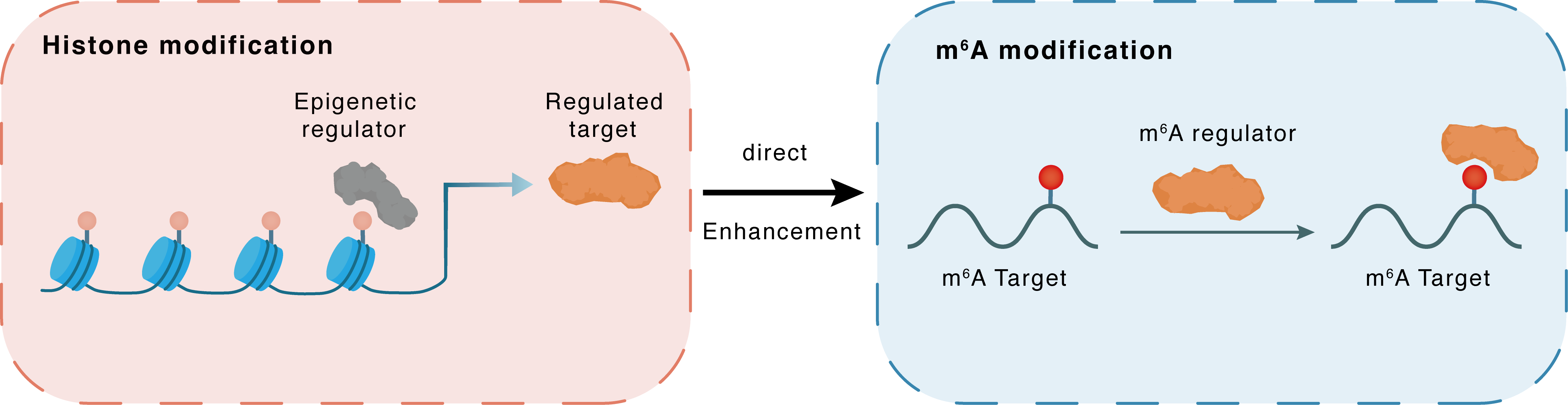
| Epigenetic Regulation Type | Histone modification (HistMod) | ||||
| Epigenetic Regulator | L-lactate dehydrogenase B chain (LDHB) | WRITER | View Details | ||
| Regulated Target | Histone H3 lysine 18 lactylation (H3K18la) | View Details | |||
| Downstream Gene | YTHDF2 | View Details | |||
| Crosstalk Relationship | Histone modification → m6A | Enhancement | |||
| Crosstalk Mechanism | histone modification directly impacts m6A modification through modulating the level of m6A regulator | ||||
| Crosstalk Summary | Here, we show histone lactylation is elevated in tumors and is associated with poor prognosis of ocular melanoma. Target correction of aberrant histone lactylation triggers therapeutic efficacy both in vitro and in vivo. Mechanistically, LDHA/LDHB-mediated Histone H3 lysine 18 lactylation (H3K18la) contributes to tumorigenesis by facilitating YTHDF2 expression. Moreover, YTHDF2 recognizes the m6A modified Period circadian protein homolog 1 (PER1) and TP53 mRNAs and promotes their degradation, which accelerates tumorigenesis of ocular melanoma. | ||||
| Responsed Disease | Melanoma of uvea | ICD-11: 2D0Y | |||
In-vitro Model |
92-1 [Human uveal melanoma] | Uveal melanoma | Homo sapiens | CVCL_8607 | |
| MuM-2B | Uveal melanoma | Homo sapiens | CVCL_3447 | ||
| OCM-1 | Amelanotic melanoma | Homo sapiens | CVCL_6934 | ||
| Mel290 | Uveal melanoma | Homo sapiens | CVCL_C304 | ||
| OMM-1 | Uveal melanoma | Homo sapiens | CVCL_6939 | ||
| CRMM-1 | Conjunctival melanoma | Homo sapiens | CVCL_M593 | ||
| CRMM-2 | Conjunctival melanoma | Homo sapiens | CVCL_M594 | ||
| CM2005.1 | Conjunctival melanoma | Homo sapiens | CVCL_M592 | ||
| PIG1 | Normal | Homo sapiens | CVCL_S410 | ||
| HEK293T | Normal | Homo sapiens | CVCL_0063 | ||
| In-vivo Model | Briefly, nude mice were anesthetized by intraperitoneal injection of a ketamine (final concentration: 10 mg/mL) and xylazine (final concentration: 1 mg/mL) mixture (0.01 mL/g mouse weight). Then, the mouse sclera was pre-perforated using a sharp 30-gauge injection needle. Ocular melanoma cells (5 × 10⁵) were injected through the hole made in the choroid by a 33-gauge blunt-end microinjection needle (7803-05, Hamilton, Reno, NV, USA). Then, the infected eyes were treated with ophthalmic bacitracin ointment. All animal experiments were approved by the Animal Care and Use Committee at Shanghai Jiao Tong University School of Medicine. | ||||
Full List of Potential Compound(s) Related to This m6A-centered Crosstalk
| 2D0Y: Melanoma of uvea | 1 Compound(s) Regulating the Disease | Click to Show/Hide the Full List | ||
 Compound Name Compound Name |
Hepzato | Phase 3 | [2] | |
|---|---|---|---|---|
| External Link | ||||
References