
m6A-centered Crosstalk Information
Mechanism of Crosstalk between m6A Modification and Epigenetic Regulation
| Crosstalk ID |
M6ACROT02244
|
[1], [2] | |||
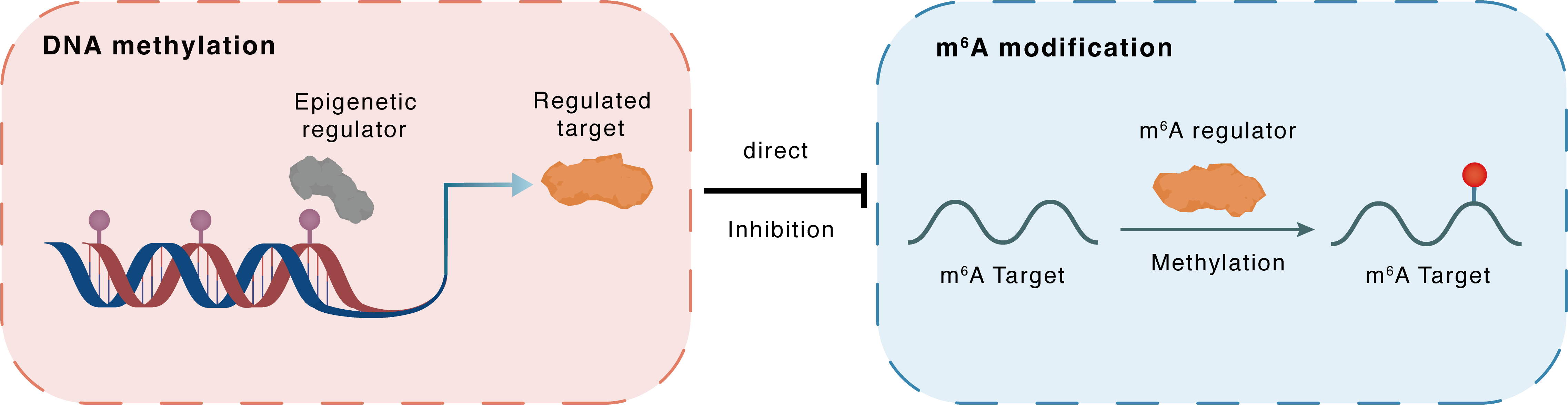 DNA methylation
DNMT3A
METTL14
Direct
Inhibition
m6A modification
SLC7A11
SLC7A11
METTL14
Methylation
DNA methylation
DNMT3A
METTL14
Direct
Inhibition
m6A modification
SLC7A11
SLC7A11
METTL14
Methylation
 : m6A sites : m6A sites
|
|||||
| m6A Modification: | |||||
|---|---|---|---|---|---|
| m6A Regulator | Methyltransferase-like 14 (METTL14) | WRITER | |||
| m6A Target | Cystine/glutamate transporter (SLC7A11) | ||||
| Epigenetic Regulation that have Cross-talk with This m6A Modification: | |||||
| Epigenetic Regulation Type | DNA methylation (DNAMeth) | ||||
| Epigenetic Regulator | Cysteine methyltransferase DNMT3A (DNMT3A) | WRITER | View Details | ||
| Regulated Target | Methyltransferase-like protein 14 (METTL14) | View Details | |||
| Crosstalk Relationship | DNA methylation → m6A | Inhibition | |||
| Crosstalk Mechanism | DNA methylation directly impacts m6A modification through modulating the expression level of m6A regulator | ||||
| Crosstalk Summary | lncRNA UCA1 recruited DNA methyltransferase (DNMT1, DNMT3A, and DNMT3B) to the METTL14 promoter region to inhibit METTL14 expression in breast cancer. m6A-hypomethylation regulated FGFR4 phosphorylates GSK-3beta and activates beta-catenin/TCF4-Cystine/glutamate transporter (SLC7A11)/FPN1 signaling to drive anti-HER2 resistance. Knockdown of METTL14 significantly increased the expression level of FGFR4 in HER2-positive breast cancer cells. FGFR4 reduced the sensitivity of HER2-positive breast cancer to trastuzumab plus pertuzumab or tucatinib. These results pinpoint a mechanism of anti-HER2 resistance and provide a strategy for overcoming resistance via FGFR4 inhibition in recalcitrant HER2-positive breast cancer. | ||||
| Responsed Disease | Breast cancer | ICD-11: 2C60 | |||
| Responsed Drug | Tucatinib | ||||
| Pathway Response | Wnt signaling pathway | hsa04310 | |||
| Cell Process | Glutathione synthesis | ||||
In-vitro Model |
MDA-MB-453 | Breast adenocarcinoma | Homo sapiens | CVCL_0418 | |
| MDA-MB-361 | Breast adenocarcinoma | Homo sapiens | CVCL_0620 | ||
| SK-BR-3 | Breast adenocarcinoma | Homo sapiens | CVCL_0033 | ||
| BT-474 | Invasive breast carcinoma | Homo sapiens | CVCL_0179 | ||
| AU565 | Breast adenocarcinoma | Homo sapiens | CVCL_1074 | ||
| MCF-7 | Invasive breast carcinoma | Homo sapiens | CVCL_0031 | ||
| T-47D | Invasive breast carcinoma | Homo sapiens | CVCL_0553 | ||
| ZR-75-1 | Invasive breast carcinoma | Homo sapiens | CVCL_0588 | ||
| MDA-MB-231 | Breast adenocarcinoma | Homo sapiens | CVCL_0062 | ||
| BT-549 | Invasive breast carcinoma | Homo sapiens | CVCL_1092 | ||
| MDA-MB-468 | Breast adenocarcinoma | Homo sapiens | CVCL_0419 | ||
| SUM159PT | Breast pleomorphic carcinoma | Homo sapiens | CVCL_5423 | ||
| MCF-10A | Normal | Homo sapiens | CVCL_0598 | ||
| HEK293T | Normal | Homo sapiens | CVCL_0063 | ||
| In-vivo Model | Luciferase-labeled rSKBR3 and MDA-MB-361 cells (1 × 10⁷ cells) mixed with 1:1 Matrigel (Corning, 356237) were subcutaneously injected into the fat pads of mice. After a tumor was palpable, the mice were randomized into four groups (five mice per group), and they were treated with vehicle, trastuzumab (20 mg/kg, intraperitoneal administration), roblitinib (30 mg/kg, oral administration), or a combination of both drugs. | ||||
Full List of Potential Compound(s) Related to This m6A-centered Crosstalk
| Cysteine methyltransferase DNMT3A (DNMT3A) | 8 Compound(s) Regulating the Target | Click to Show/Hide the Full List | ||
 Compound Name Compound Name |
PMID27376512-Compound-Figure3CN | Patented | [3] | |
|---|---|---|---|---|
| MOA | Inhibitor | |||
| Activity | EC50 = 1100 nM | |||
| External Link | ||||
| Compound Name |
PMID27376512-Compound-Figure3CG | Patented | [3] | |
| MOA | Inhibitor | |||
| Activity | EC50 = 2400 nM | |||
| External Link | ||||
| Compound Name |
PMID27376512-Compound-Figure3CM | Patented | [3] | |
| MOA | Inhibitor | |||
| Activity | EC50 = 1100 nM | |||
| External Link | ||||
| Compound Name |
PMID27376512-Compound-Figure2aExample1 | Patented | [3] | |
| MOA | Inhibitor | |||
| Activity | IC50 = 3000 nM | |||
| External Link | ||||
| Compound Name |
PMID27376512-Compound-MTC-424 | Patented | [3] | |
| MOA | Inhibitor | |||
| Activity | IC50 = 1940 nM | |||
| External Link | ||||
| Compound Name |
PMID27376512-Compound-MTC-427 | Patented | [3] | |
| MOA | Inhibitor | |||
| Activity | IC50 = 295 nM | |||
| External Link | ||||
| Compound Name |
PMID27376512-Compound-MTC-422 | Patented | [3] | |
| MOA | Inhibitor | |||
| Activity | IC50 = 1430 nM | |||
| External Link | ||||
| Compound Name |
PMID27376512-Compound-MTC-423 | Patented | [3] | |
| MOA | Inhibitor | |||
| Activity | IC50 = 363 nM | |||
| External Link | ||||
| Cystine/glutamate transporter (SLC7A11) | 1 Compound(s) Regulating the Target | Click to Show/Hide the Full List | ||
| Compound Name |
SXC-2023 | Phase 2 | [4] | |
| MOA | Activator | |||
| External Link | ||||
| 2C60: Breast cancer | 2 Compound(s) Regulating the Disease | Click to Show/Hide the Full List | ||
| Compound Name |
Entrectinib | Approved | [5] | |
| Synonyms |
1108743-60-7; RXDX-101; UNII-L5ORF0AN1I; Entrectinib (RXDX-101); L5ORF0AN1I; Benzamide, N-[5-[(3,5-difluorophenyl)methyl]-1H-indazol-3-yl]-4-(4-methyl-1-piperazinyl)-2-[(tetrahydro-2H-pyran-4-yl)amino]-; Benzamide, N-(5-((3,5-difluorophenyl)methyl)-1H-indazol-3-yl)-4-(4-methyl-1-piperazinyl)-2-((tetrahydro-2H-pyran-4-yl)amino)-; Entrectinib [USAN:INN]; YMX; Kinome_2659; Entrectinib(rxdx-101); Entrectinib (USAN/INN); SCHEMBL3512601; GTPL8290; CHEMBL1983268; KS-00000TSK
Click to Show/Hide
|
|||
| External Link | ||||
| Compound Name |
Everolimus | Approved | [6] | |
| External Link | ||||
References