
m6A-centered Crosstalk Information
Mechanism of Crosstalk between m6A Modification and Epigenetic Regulation
| Crosstalk ID |
M6ACROT05621
|
[1] | |||
 m6A modification
NEAT1
NEAT1
ALKBH5
Demethylation
m6A modification
NEAT1
NEAT1
ALKBH5
Demethylation
 : m6A sites
Direct
Enhancement
Non-coding RNA
NEAT1
MIR378B
lncRNA miRNA circRNA : m6A sites
Direct
Enhancement
Non-coding RNA
NEAT1
MIR378B
lncRNA miRNA circRNA
|
|||||
| m6A Modification: | |||||
|---|---|---|---|---|---|
| m6A Regulator | RNA demethylase ALKBH5 (ALKBH5) | ERASER | |||
| m6A Target | Nuclear paraspeckle assembly transcript 1 (NEAT1) | ||||
| Epigenetic Regulation that have Cross-talk with This m6A Modification: | |||||
| Epigenetic Regulation Type | Non-coding RNA (ncRNA) | ||||
| Epigenetic Regulator | Nuclear paraspeckle assembly transcript 1 (NEAT1) | LncRNA | View Details | ||
| Regulated Target | MicroRNA 378b (MIR378B) | View Details | |||
| Crosstalk Relationship | m6A → ncRNA | Enhancement | |||
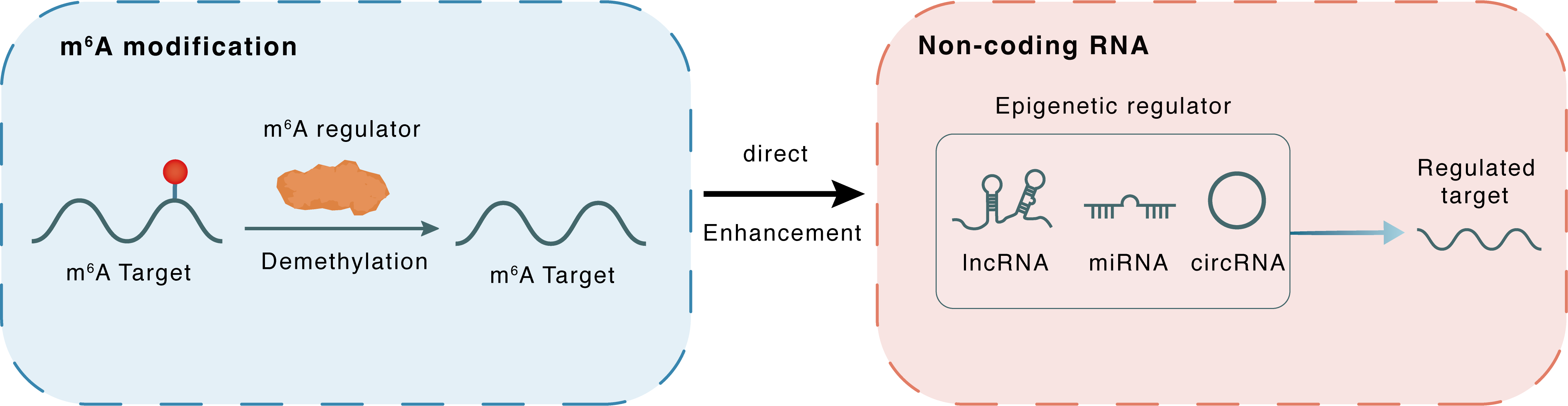
| Crosstalk Mechanism | m6A regulators directly modulate the functionality of ncRNAs through specific targeting ncRNA | ||||
| Crosstalk Summary | ALKBH5 knockdown suppressed cell proliferation, migration and invasion of infantile hemangioma cells, while promoting cell apoptosis. ALKBH5 promoted lncRNA Nuclear paraspeckle assembly transcript 1 (NEAT1) expression by reducing the m6A modification of lncRNA NEAT1. In addition, MicroRNA 378b (MIR378B) was the target of lncRNA NEAT1, and its overexpression reversed the promotion effect of lncRNA NEAT1 overexpression on IH cell tumor-like behaviors. | ||||
| Responsed Disease | Infantile hemangioma | ICD-11: 2E81 | |||
| Cell Process | Cell proliferation | ||||
| Cell migration | |||||
| Cell invasion | |||||
In-vitro Model |
XPTS-1 | Infantile hemangioma | Homo sapiens | CVCL_9U60 | |
| HEK293T | Normal | Homo sapiens | CVCL_0063 | ||
| In-vivo Model | A total of 32 BALB/c nude mice (male, 5-week-old) were chosen and assigned to four groups: (1) Control group (injected with XPTS-1 cells), (2) sh-NC (injected with XPTS-1 cells with sh-NC transfection), (3) sh-ALKBH5 (injected with XPTS-1 cells with sh-ALKBH5 transfection) and (4) sh-FOSL1 group (injected with XPTS-1 cells with sh-FOSL1 transfection) (8 mice/group). The third-generation XPTS-1 cells were used for tumor induction. 0.2 mL of the above cell suspensions containing 2 × 10⁴ cells were injected into the back of each mouse. | ||||