
m6A-centered Crosstalk Information
Mechanism of Crosstalk between m6A Modification and Epigenetic Regulation
| Crosstalk ID |
M6ACROT03229
|
[1] | |||
 Histone modification
H3K4me3
PHF20
METTL14
Direct
Enhancement
m6A modification
HOXA13
HOXA13
METTL14
Methylation
Histone modification
H3K4me3
PHF20
METTL14
Direct
Enhancement
m6A modification
HOXA13
HOXA13
METTL14
Methylation
 : m6A sites : m6A sites
|
|||||
| m6A Modification: | |||||
|---|---|---|---|---|---|
| m6A Regulator | Methyltransferase-like 14 (METTL14) | WRITER | |||
| m6A Target | Homeobox protein Hox-A13 (HOXA13) | ||||
| Epigenetic Regulation that have Cross-talk with This m6A Modification: | |||||
| Epigenetic Regulation Type | Histone modification (HistMod) | ||||
| Epigenetic Regulator | PHD finger protein 20 (PHF20) | READER | View Details | ||
| Regulated Target | Histone H3 lysine 4 trimethylation (H3K4me3) | View Details | |||
| Downstream Gene | METTL14 | View Details | |||
| Crosstalk Relationship | Histone modification → m6A | Enhancement | |||
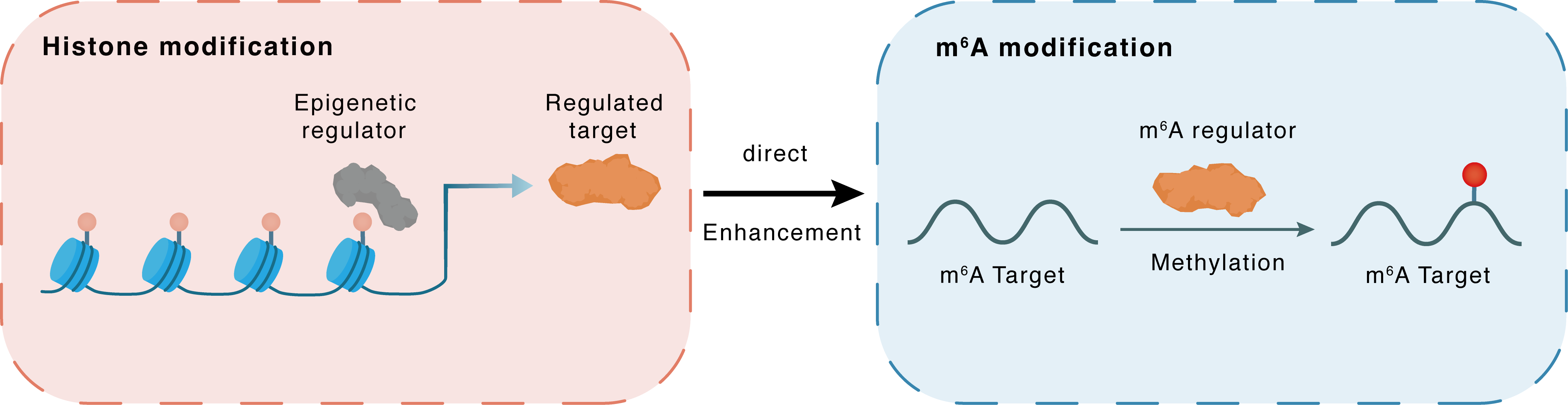
| Crosstalk Mechanism | histone modification directly impacts m6A modification through modulating the level of m6A regulator | ||||
| Crosstalk Summary | PHF20 elevated METTL14 expression by enhancing the enrichment of Histone H3 lysine 4 trimethylation (H3K4me3) on its promoter, and METTL14 strengthened Homeobox protein Hox-A13 (HOXA13) m6A methylation to maintain HOXA13 mRNA stability through IGF2BP3. In conclusion, PHF20 elevates METTL14 expression by enhancing H3K4me3 enrichment on its promoter and enhances HOXA13 mRNA stability via IGF2BP3-mediated m6A modification, thus facilitating HOXA13 expression and eventually inducing osteogenic differentiation of BMSCs. | ||||